What Would Sun Tzu Do?
What would Sun Tzu do in a war between Iran and the United States? This essay examines strategy, pride, escalation, the Strait of Hormuz, and how military power can be converted into a political settlement.
Strategy, Pride, and the Search for Victory
By Edward Miranda, July 2026
“The supreme art of war is to subdue the enemy without fighting.”
Sun Tzu, The Art of War
More than twenty-five centuries ago, Sun Tzu wrote those words not as an idealistic plea for peace but as a practical definition of strategic excellence. Victory, in his view, was measured not by the destruction left behind but by the political condition achieved when the fighting ended. His short treatise on war was, at its core, an argument against the careless use of war. He did not romanticize combat, and he did not measure greatness by the number of cities destroyed, soldiers killed, or enemies humiliated. He understood that war consumes the very power it is intended to protect. Armies exhaust themselves, treasuries empty, alliances fracture, and populations lose confidence, while tactical victories accumulate even as the political purpose of the conflict quietly disappears. That distinction between destruction and victory is essential when considering the war between Iran and the United States.
As of mid-July 2026, the conflict has moved well beyond the initial exchange of military blows. American strikes have targeted Iranian military assets and critical infrastructure. Iran has retaliated against targets connected to the United States and against regional states hosting American forces, extending the effects of the war into Kuwait, Bahrain, Jordan, Qatar, and Saudi Arabia. Commercial traffic through the Strait of Hormuz has become the central axis of confrontation. A ceasefire framework signed in June, intended to halt attacks and reopen maritime transit for sixty days, collapsed in early July, and negotiations continue intermittently through regional intermediaries in Oman and Qatar. The dispute is no longer confined to military capability, nuclear development, sanctions, or freedom of navigation. It has become entangled with national honor, political pride, leadership legitimacy, revenge, and institutional survival. Those forces are harder to bomb than missile sites, and they are considerably more dangerous.
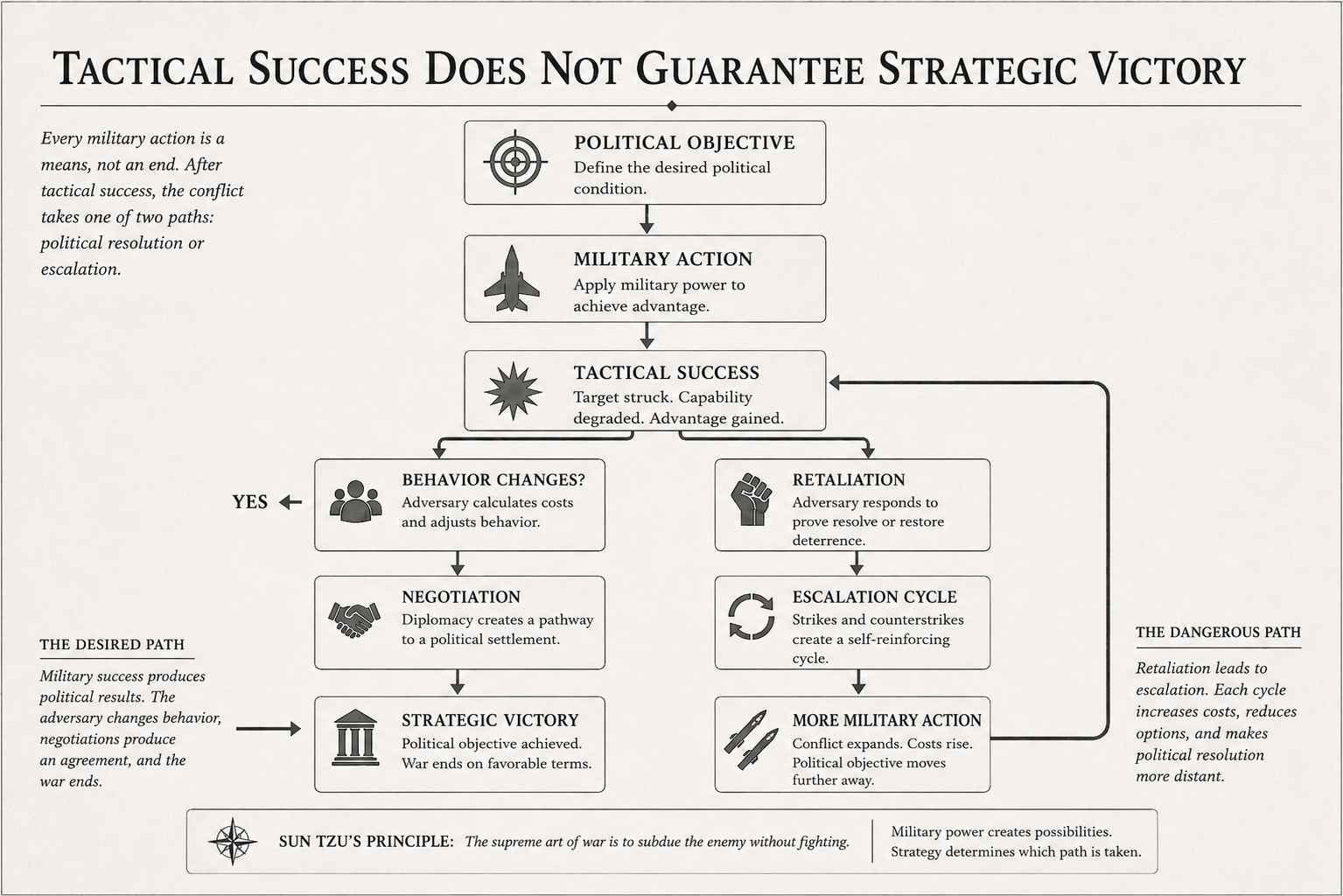
Sun Tzu would recognize the central strategic problem immediately. The objectives being pursued are no longer entirely material. Each government must now answer not only to the opposing side but to its own population, its political factions, its military institutions, its allies, and its historical identity. The United States cannot easily appear to retreat after employing overwhelming force and publicly insisting that Iranian behavior must change. Iran cannot easily accept an outcome that appears to reward the killing of its leaders, the destruction of its infrastructure, and the violation of its sovereignty. Every strike therefore produces two effects at once. It damages a physical target, and it strengthens a political obligation to respond. The war is becoming self-sustaining.
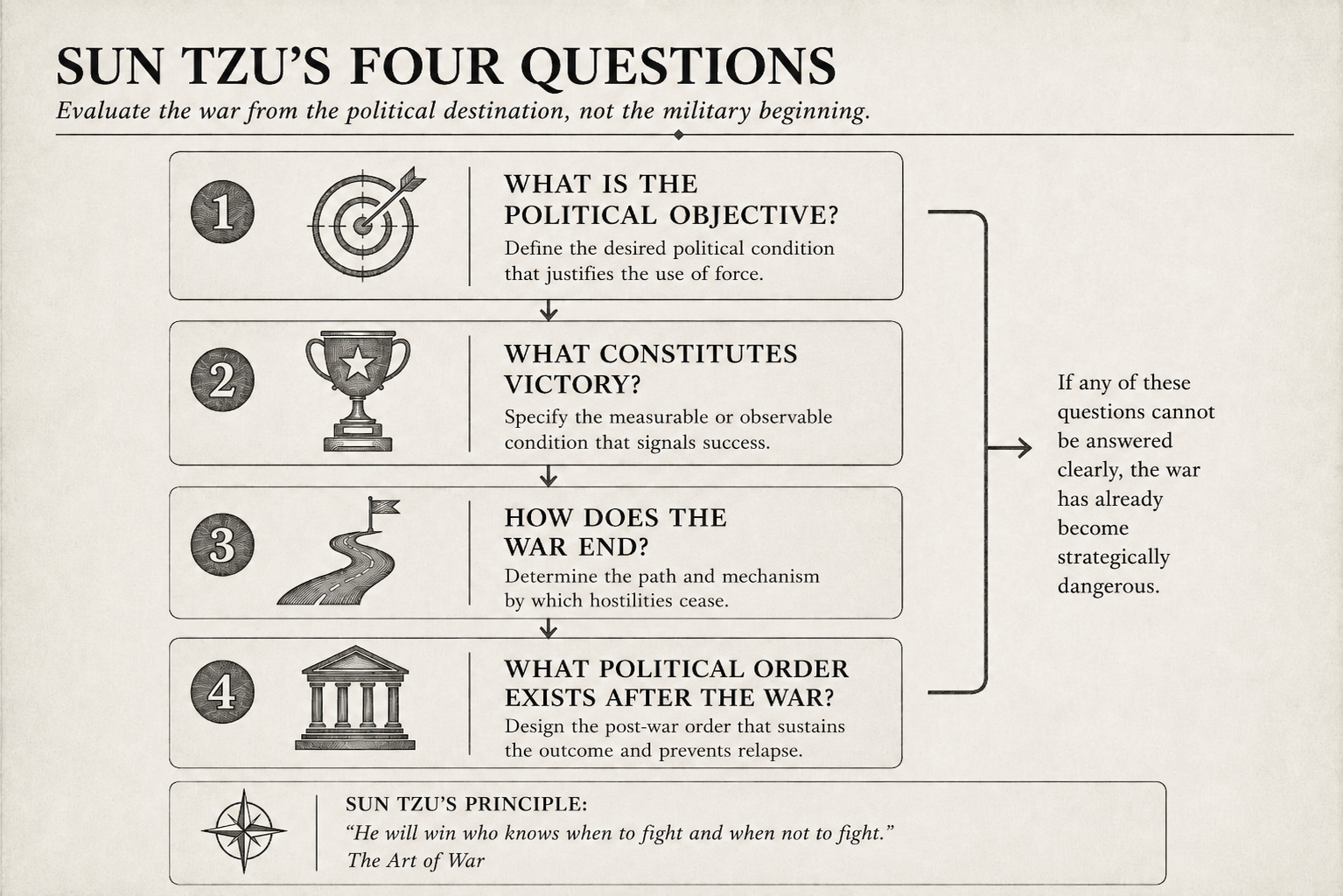
Sun Tzu would not begin by asking which country possesses more aircraft, ships, missiles, satellites, or financial resources, because the answer is obvious. The United States holds overwhelming conventional superiority. He would instead pose four more consequential questions: what the political objective is, what would constitute victory, how the war ends, and what political order will exist the day after it ends. A leadership that cannot answer those questions clearly may discover that military superiority has become a liability. The stronger nation can strike more targets, expand more missions, and assume more obligations without moving any closer to a stable conclusion. Sun Tzu would identify that condition as the defining danger facing Washington.
The Difference Between Power and Victory
The United States can damage Iran far more severely than Iran can damage the United States. It can destroy command centers, naval facilities, missile launchers, energy infrastructure, transportation networks, communications systems, and government compounds. Destruction, however, is an action rather than an objective, and the strategic question is what behavior the destruction is expected to produce. The candidate outcomes include persuading Iran to abandon its nuclear ambitions, compelling unrestricted passage through the Strait of Hormuz, permanently reducing Iranian regional influence, forcing the government to capitulate, producing regime change, and generating a more moderate political order. Each of those outcomes requires a different strategy. Some may be achievable, others may be impossible through airpower alone, and several contradict one another.
A campaign designed to compel negotiation must leave the adversary with something worth negotiating to preserve. A campaign designed to overthrow a government may cause that same government to reject compromise, because compromise no longer guarantees survival. This is one of the great paradoxes of coercive power. The more completely a state threatens the existence of its adversary, the less influence it may possess over that adversary's behavior. A leadership that believes it can survive through restraint may choose restraint. A leadership that believes it will be destroyed regardless of its conduct has little reason to compromise.
Sun Tzu would therefore distinguish between the ability to punish Iran and the ability to govern Iran's choices, because they are not the same capability. The United States may win nearly every direct military encounter and still fail to produce a political settlement. History records many wars in which the materially stronger power dominated the battlefield yet could not translate that dominance into a durable political order. Sun Tzu warned against exactly this confusion when he argued that the object of war is victory rather than lengthy campaigns, and that no country has ever profited from prolonged warfare. For Sun Tzu, victory is not the continuation of successful military operations. Victory is the point at which military operations are no longer necessary.
Iran's Objective Is Not Conventional Victory
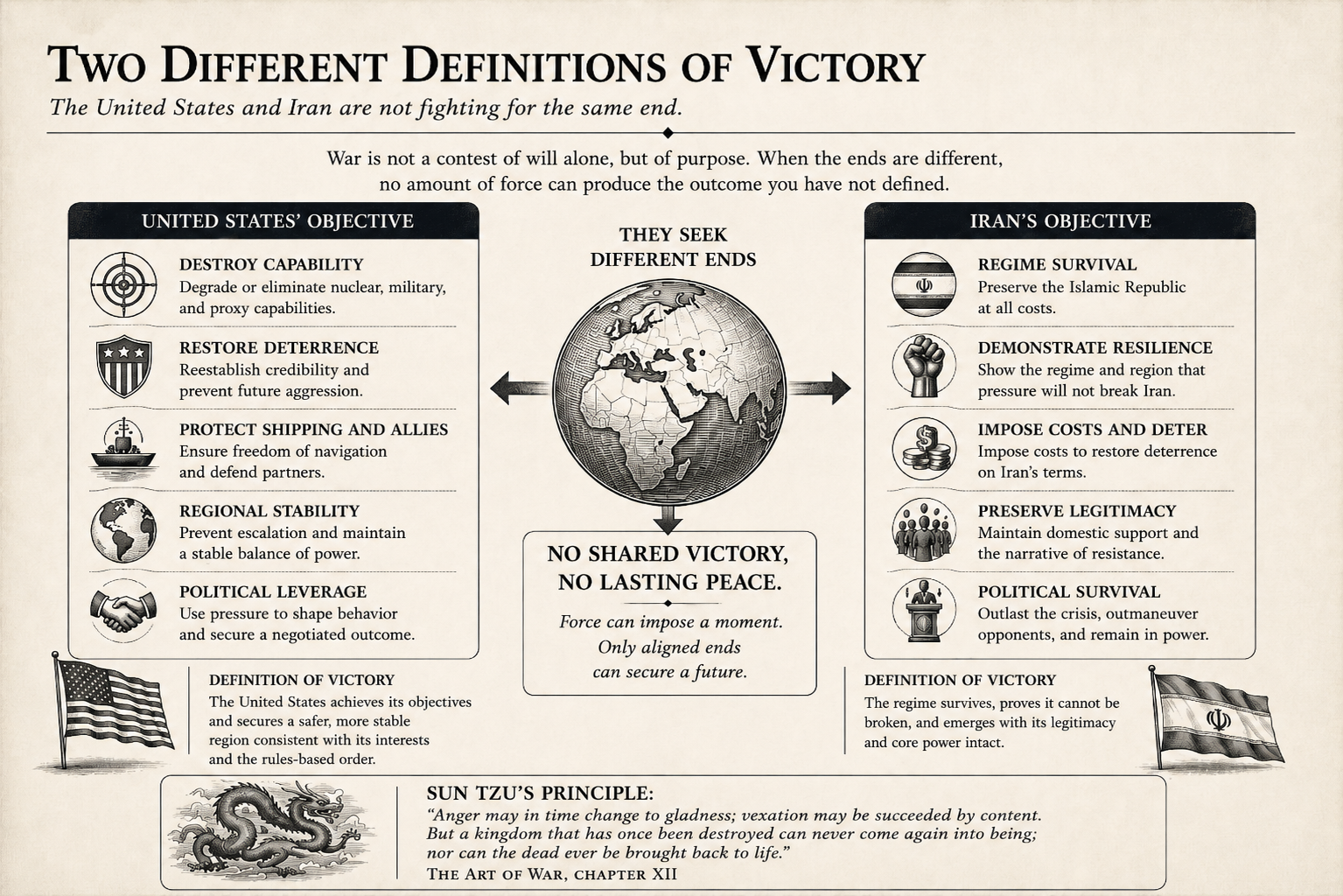
Iran cannot defeat the United States in a conventional war, and its leaders know it. They cannot destroy the American military, occupy American territory, eliminate American regional influence, or force a complete withdrawal through battlefield superiority. Iran must therefore define victory differently. Its plausible objectives are survival, deterrence, endurance, preservation of the governing system, retention of sufficient capability to impose costs, and maintenance of a credible claim to regional relevance. Iran does not need to defeat the United States in the traditional sense. It needs to demonstrate that the United States cannot achieve its objectives at an acceptable price.
That requirement changes the nature of the contest. The United States counts destroyed missiles, aircraft, command facilities, and naval assets. Iran counts days survived, attacks answered, shipping disrupted, oil prices elevated, alliances strained, and political pressure accumulated inside the United States. The two governments are operating with entirely different definitions of success, and this is precisely the type of asymmetry Sun Tzu would study. He understood that the weaker side should never accept the stronger side's preferred form of warfare. Iran's rational strategy is to avoid a decisive conventional contest, disperse its capabilities, preserve enough retaliatory power, exploit geography, activate regional pressure points, and extend the conflict until the political costs to Washington exceed the perceived benefits.
None of this makes Iranian conduct wise or morally defensible. Attacks on civilian infrastructure, commercial vessels, and neighboring states may be simultaneously destructive and strategically counterproductive. Recent Iranian operations have expanded the number of regional governments directly affected by the war, and each expansion carries a cost that Tehran appears reluctant to acknowledge. Sun Tzu would warn that indiscriminate widening of the war converts potential mediators into enemies. Iran's greatest strategic asset is not its missile inventory. It is the possibility that regional states may prefer accommodation to prolonged instability, and every unnecessary attack on those states diminishes that advantage. Revenge may satisfy internal demands, but revenge is not automatically strategy.
The Entry of Pride
War becomes especially dangerous when political leaders begin defending themselves rather than defending national objectives, because pride changes the calculation. For American leadership, restraint can be portrayed domestically as weakness. Once force has been used and public threats have been issued, every unresolved Iranian challenge becomes a test of credibility, and the president may fear that ending the campaign without visible submission from Iran will be interpreted as defeat. Iran's leadership faces a different but equally powerful pressure. It must demonstrate that the country cannot be attacked, its leaders killed, and its infrastructure destroyed without consequence. Failure to respond may be read not merely as military restraint but as ideological collapse.
The conflict then becomes a contest over narratives. The United States must show that Iran was compelled, while Iran must show that it resisted, and the requirement to preserve those narratives can become more influential than the original causes of the war. Sun Tzu would consider this a grave strategic deterioration, because pride makes objectives unlimited. A physical target can be destroyed, a territorial dispute can be negotiated, and a shipping arrangement can be codified, but there is no objective measure of how much destruction satisfies honor, how many retaliatory strikes answer revenge, or at what point credibility has been restored. Wars of pride are therefore difficult to end. Each side interprets the other's restraint as evidence that pressure is working, while interpreting its own restraint as potential humiliation, so both sides continue. The enemy is no longer simply the opposing state. The enemy is the political meaning attached to stopping.
Attack the Strategy
Sun Tzu places the highest value on attacking an adversary's strategy before attacking its armies or its cities, and applying that principle to the present conflict would produce a different American campaign. Iran's strategy is to survive, preserve retaliatory capacity, impose regional costs, threaten maritime commerce, and make the political price of continued American action increasingly burdensome. The United States should therefore concentrate on defeating that strategy rather than maximizing destruction. Such a campaign would prioritize protecting commercial shipping, strengthening missile and drone defenses, maintaining cohesion among Gulf partners, preventing Iran from dividing the coalition, insulating energy markets where possible, and communicating a credible but limited set of conditions for ending hostilities.
Bombing additional infrastructure certainly damages Iran. If those attacks simultaneously increase regional anger, strengthen internal Iranian unity, elevate oil prices, widen retaliation, and make negotiation politically impossible, they reinforce the very strategy Washington is trying to defeat. Sun Tzu would evaluate every prospective target by determining whether its destruction makes the desired political ending more likely. When the answer is unclear, the target may be tactically valuable and strategically harmful at the same time.
He would apply the same logic to Iran. Iran's strategy should be to preserve the country and prevent political subordination. Attacking neighboring states, damaging desalination facilities, and threatening civilian economic systems undermine that objective, because such operations push regional governments toward deeper dependence on American protection and make the international isolation of Iran easier to organize. Iran may achieve revenge while destroying its own diplomatic position. Sun Tzu would call that a failure to distinguish emotion from interest.
The Strait of Hormuz
“Ground the possession of which imports great advantage to either side is contentious ground.”
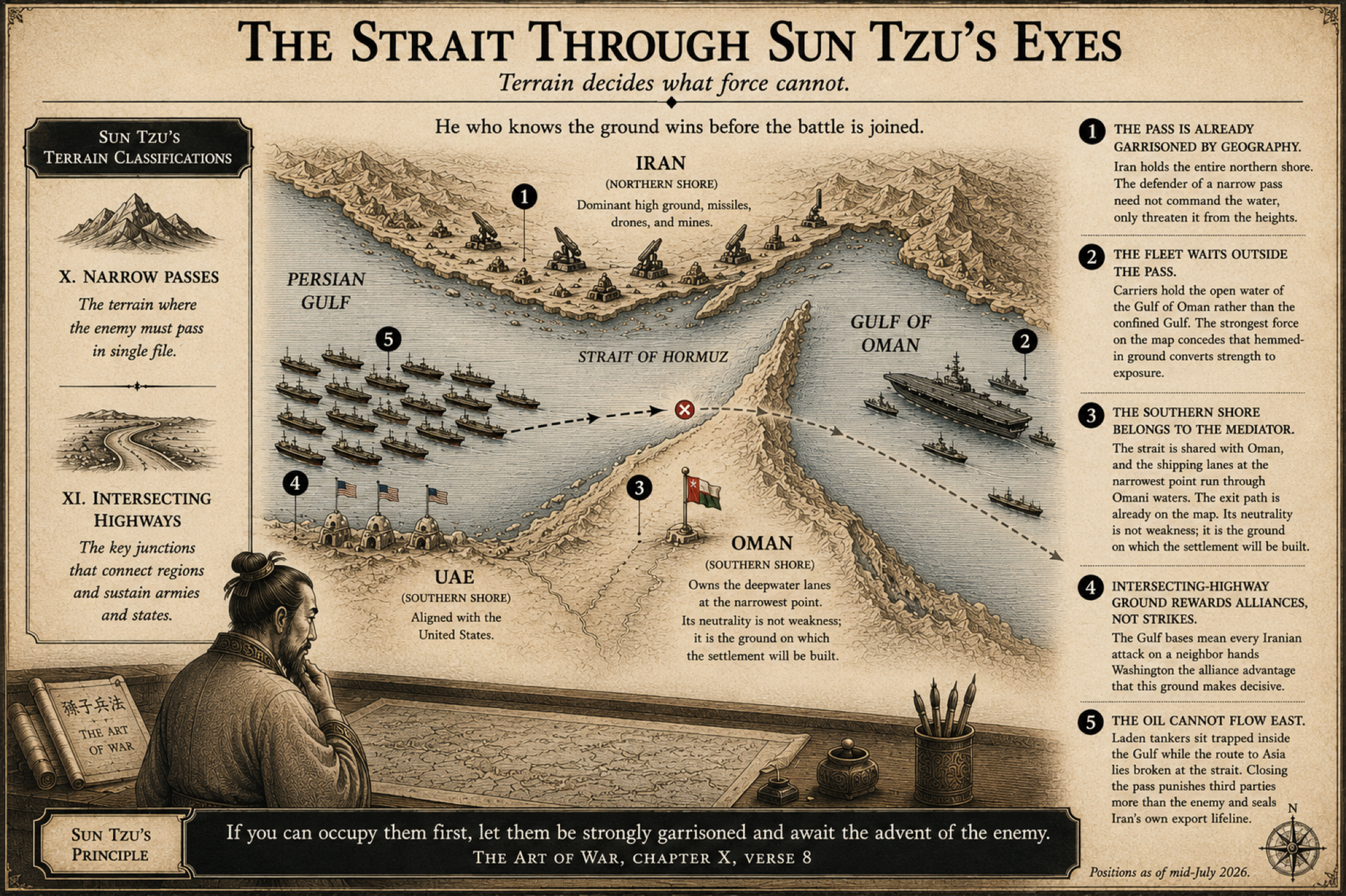
The Strait of Hormuz is not merely a narrow passage of water. It is the geographical point at which Iranian regional power, American naval power, global energy markets, and the sovereignty concerns of the Gulf states converge, and the confrontation surrounding it illustrates the difference between military control and political control. The United States can escort vessels, deploy naval forces, attack Iranian maritime assets, and attempt to guarantee freedom of navigation. Iran can threaten ships, deploy missiles and drones, lay mines, manufacture uncertainty, and raise insurance and transportation costs without ever permanently closing the waterway. Neither side needs absolute control to shape the strategic environment. The United States requires shipping to move safely and predictably, while Iran obtains leverage merely by making that movement uncertain and expensive.
This asymmetry explains why negotiations have repeatedly returned to maritime access, shipping guarantees, and the terms under which Iran might accept or administer an arrangement governing transit. Indirect discussions through Qatar and Oman have centered on the strait, while disputes over authority, tolls, and enforcement have prevented resolution. Sun Tzu would conclude that neither side can obtain a stable outcome by demanding that the other publicly surrender its fundamental claim. Iran cannot credibly declare that the United States holds exclusive authority over waters adjacent to Iranian territory. The United States cannot accept an Iranian right to close or tax an international maritime passage at will.
The strategic solution therefore requires ambiguity. Commercial shipping could resume under an internationally mediated security arrangement in which Oman, Qatar, or a broader maritime group supervises communications and transit procedures. Iran could describe the agreement as recognition of its legitimate security role, while the United States could describe the same agreement as a guarantee of unrestricted navigation, and both descriptions could coexist. Modern audiences often dismiss such ambiguity as diplomatic weakness. Sun Tzu would recognize it as strategic utility, because language can create the political space that military action has eliminated. A settlement does not require both parties to agree on the meaning of victory. It requires both parties to prefer the settlement to continued war.
The Strait Through Sun Tzu’s Eyes
If Sun Tzu entered a modern war room and stood before a map of the Persian Gulf, he would not begin by counting ships, aircraft, or missiles. He would begin by classifying the terrain. To him, geography was never passive background; it was an active participant in every conflict, shaping what each side could and could not accomplish before the first order was ever given. The Strait of Hormuz would immediately appear as a narrow pass already occupied by geography itself, where a defender requires neither command of the sea nor numerical superiority, only the ability to threaten movement through a confined corridor. He would also recognize the region as intersecting-highway ground, where alliances, commerce, and political relationships become as decisive as military force. The map would reveal far more than opposing fleets. It would expose leverage, vulnerability, mediation, and dependence.
Looking across the map, Sun Tzu would notice something that many modern strategists overlook. The strongest military force remains outside the narrow passage in the open waters of the Gulf of Oman, while the greatest concentration of commercial shipping lies trapped inside the Persian Gulf waiting for safe passage east. The geography itself explains that decision. Powerful fleets avoid confined waters where maneuver is restricted, while commerce has no alternative but to pass through the choke point. Iran’s missile, drone, and mine positions dominate the northern heights. Oman occupies the southern shore through which the internationally recognized deep-water shipping lanes pass, placing a neutral mediator at the very center of the crisis. Every feature on the map reinforces the same strategic lesson: terrain shapes choices long before weapons determine outcomes.
Yet after tracing every coastline, every shipping lane, and every military position, Sun Tzu would ask a final question that no map can answer. Where is the political objective? Geography explains how nations fight, but it cannot explain why they continue fighting or what political condition they hope to create when the war is over. Until that objective is clearly defined, every additional deployment, strike, or retaliation risks becoming movement without direction. The map reveals the battlefield. It does not reveal the destination.
Leave the Enemy a Way Out
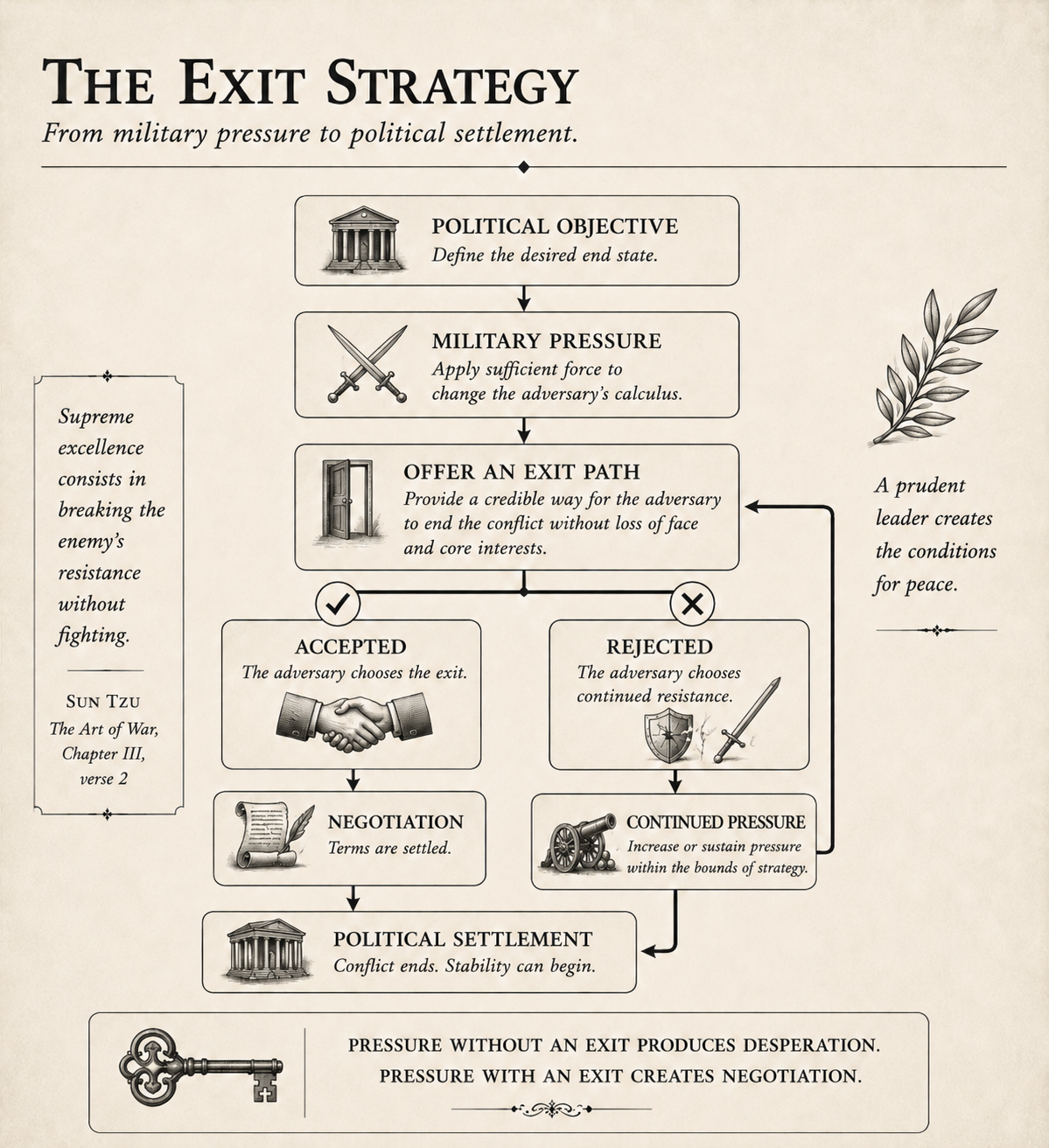
One of Sun Tzu's most psychologically sophisticated principles holds that a surrounded enemy should never be deprived of every possible escape. The purpose is not compassion but control. An enemy that retains a path to survival may be influenced, while an enemy convinced that destruction is inevitable becomes more dangerous, because restraint no longer offers a benefit. The principle applies directly to Iran's surviving leadership. If Iranian officials believe that the United States or Israel intends to continue killing senior leaders regardless of Iranian concessions, then continued resistance becomes personally rational. They may calculate that their only protection is to impose enough cost to force the enemy to stop.
Washington must therefore decide whether its objective is behavioral change or destruction of the governing system, because it cannot credibly pursue both at the same time. To compel a negotiated change in behavior, the United States must communicate what Iran receives by complying. The package could include an end to attacks, limits on leadership targeting, defined sanctions relief, restoration of commercial trade, security guarantees, and internationally supervised reconstruction. These are not rewards for aggression. They are the other half of coercion, because a threat without an exit is not coercion at all. It is an announcement of permanent war.
Sun Tzu would insist on a private message to Tehran more precise than any public rhetoric: end attacks on American forces, neighboring states, and commercial shipping, and accept a verifiable maritime and nuclear framework, in exchange for the end of the campaign, a halt to leadership targeting, and a defined process of economic normalization. The credibility of both the punishment and the relief would determine the outcome. If Iran doubts the threatened punishment, it may continue fighting. If Iran doubts the promised relief, it may continue fighting for a different reason.
Break the Retaliation Clock
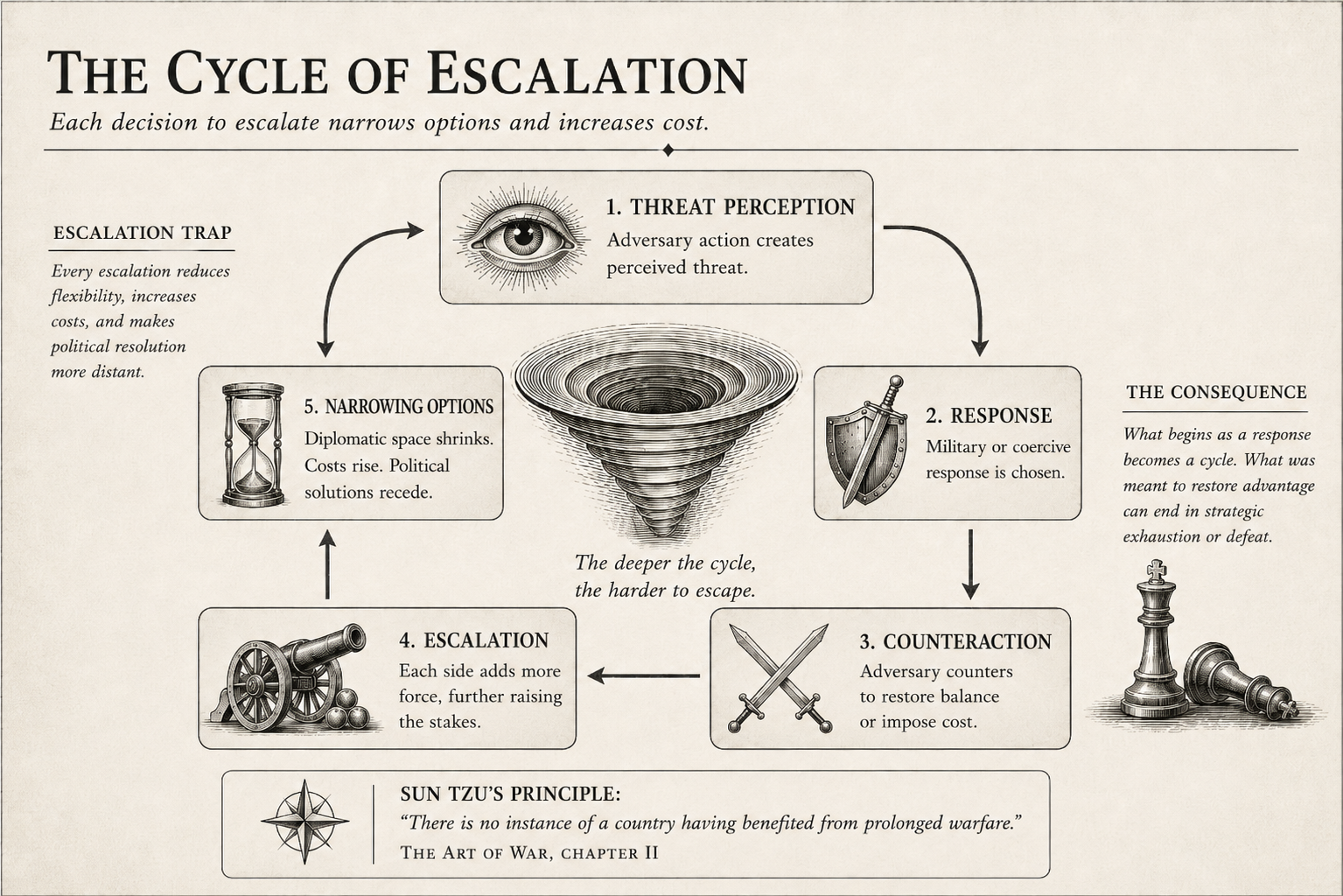
The most immediate strategic problem is the automatic cycle of retaliation. Iran attacks and the United States responds; the United States strikes and Iran answers; a base is damaged and a bridge is destroyed; a vessel is attacked and a port is blockaded. Each action is justified as a response to the previous one, and because each side describes itself as retaliating rather than initiating, neither accepts responsibility for escalation. The war develops its own clock.
Sun Tzu would attempt to interrupt that mechanism. He would use intermediaries to distinguish symbolic retaliation from strategic escalation, employing Oman, Qatar, or another trusted channel to communicate intentions, red lines, and stopping points before or immediately after operations. Such communication would not eliminate conflict, but it would prevent misinterpretation from determining its scale. The objective would be a shared understanding that a particular exchange is complete. Iran might be permitted to claim that it answered an attack without causing mass casualties, while the United States intercepts or absorbs the response and then declines to reopen a larger cycle.
This discipline would be politically difficult. American leaders would be accused of tolerating aggression, and Iranian leaders would be accused of staging meaningless retaliation. The alternative, however, is to allow every missile to create an obligation for another missile. The strongest leadership is not the leadership that always responds. It is the leadership that determines when a response serves the national objective and when it merely serves the enemy's ability to control its behavior.
Manufacture Two Victories
The most realistic path to ending the war may be an agreement that allows both governments to claim success. This proposition offends those who believe justice requires one side to acknowledge defeat, but wars rarely end when justice is perfectly satisfied. They end when political leaders can defend the outcome to the institutions and populations on which their power depends. The United States requires a narrative of compellence. Washington could declare that Iranian military capabilities had been substantially reduced, commercial shipping restored, attacks on American forces and allies halted, and Iran returned to negotiations under stricter conditions. Iran requires a narrative of resistance. Tehran could declare that it survived the combined assault, preserved its government, retaliated against its attackers, retained sovereignty, and forced the United States to recognize that Iran could not be eliminated through military power.
These narratives contradict one another, and the contradiction does not invalidate the agreement. The contradiction may be what makes the agreement possible. Sun Tzu understood that the objective is not to control every word the enemy speaks after the war. The objective is to control the material conditions that determine whether the enemy continues fighting. The United States does not need Iran to confess defeat. It needs Iran to stop attacking shipping, regional states, and American forces while accepting enforceable restrictions. Iran does not need the United States to confess defeat. It needs the war to end without the destruction of the Iranian state or the complete surrender of Iranian sovereignty. Both sides can claim more than they achieved, and that is a smaller price than continuing a war in order to force agreement over historical memory.
What Sun Tzu Would Tell Washington
“In war, then, let your great object be victory, not lengthy campaigns.”
Sun Tzu would tell American leaders that military superiority has already been demonstrated. The question is no longer whether the United States can destroy additional targets, because it plainly can. The question is whether destroying those targets creates the political condition the United States desires. He would warn against a ground invasion, because Iran's population, geography, national identity, dispersed military capacity, and history of resistance would convert occupation into an immense and unpredictable commitment. He would warn against an undefined regime-change policy, because destroying an existing government is far easier than designing the government that replaces it. He would warn against unlimited leadership targeting, because killing leaders may disrupt command structures while simultaneously elevating harder-line successors, eliminating potential negotiating partners, and persuading every surviving official that compromise offers no protection. He would warn, above all, against confusing punishment with strategy.
Most importantly, he would require Washington to state its minimum acceptable outcome, which is neither the ideal outcome nor the complete transformation of Iran but the minimum political condition under which the war can end. Without that definition, every success creates a new possibility for further action, and the campaign expands simply because expansion remains militarily available. That is how powerful nations enter wars with limited objectives and discover that they have assumed unlimited responsibilities.
What Sun Tzu Would Tell Tehran
“He will win who knows when to fight and when not to fight.”
Sun Tzu would tell Iranian leaders that national survival matters more than emotional satisfaction. Iran cannot repair the death of its leaders by sacrificing the future of the country, and it cannot defend sovereignty by prolonging a war that destroys the infrastructure on which sovereignty depends. Retaliation may be politically unavoidable, but endless retaliation is not. Iran should define victory as preservation rather than domination. It should stop attacking neighboring states, because every such attack strengthens the coalition supporting American power. It should cease attacks on civilian shipping, because those operations transform a political dispute into a threat against the international economic system. It should treat the Strait of Hormuz as negotiating leverage rather than as a mechanism of permanent global disruption, and it should accept that a negotiated limit on certain military or nuclear activities may be preferable to the destruction of the state's long-term capacity. Sun Tzu would tell Tehran that survival after confronting a vastly superior power can itself be presented as victory. Survival, however, requires knowing when to stop.
The Real Enemy
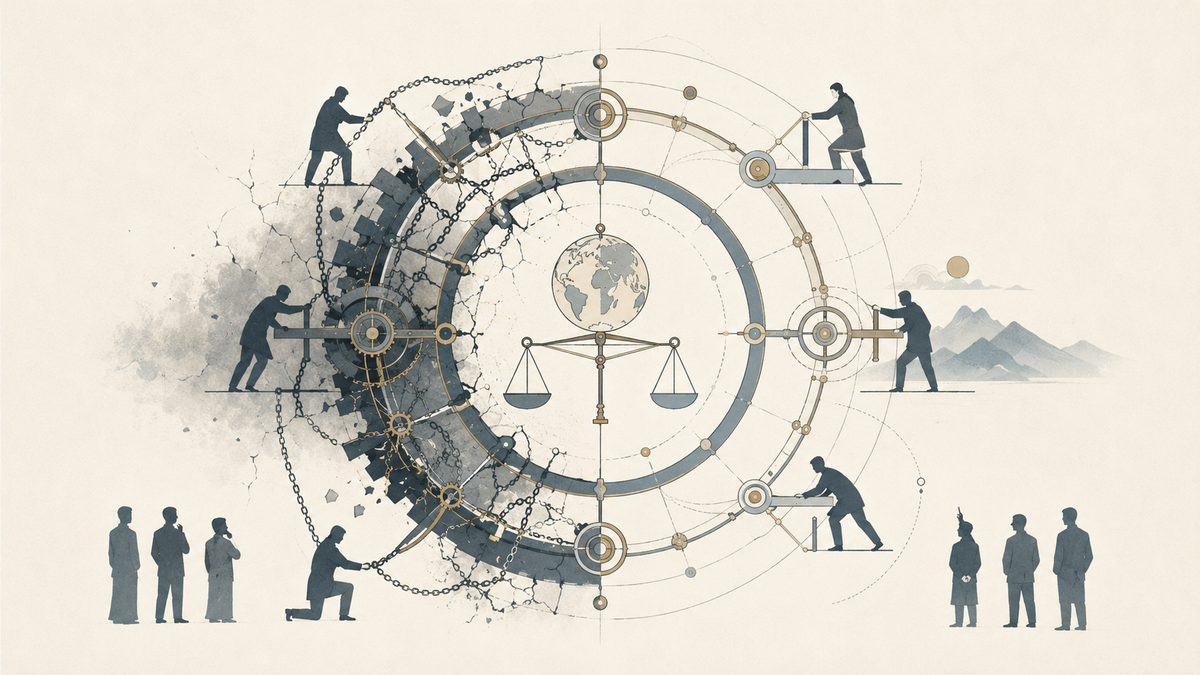
The deepest Sun Tzu reading of this war holds that neither Iran nor the United States is the final enemy. The real enemy is the cycle that has taken control of them both. That cycle consists of the belief that every attack must be answered, the fear that restraint will be interpreted as weakness, the political need to transform grief into revenge, the assumption that military capability must be used simply because it exists, and the persistent confusion of destruction with victory. Once the cycle becomes autonomous, national leaders cease making strategy. They become participants in a process whose next action has already been determined by the previous one, and that condition is the opposite of command.
Sun Tzu would attempt to restore choice. He would separate national interests from leadership pride, distinguish symbolic actions from strategic ones, and preserve enough pressure to compel negotiation while preserving enough space for the enemy to accept it. He would employ intermediaries, ambiguity, timing, economic leverage, defensive strength, and carefully limited force. Above all, he would require both governments to identify the political condition they are trying to create. If additional military operations do not bring that condition closer, then those operations are not evidence of strength. They are evidence that the war has escaped strategic control.
What Would Sun Tzu Do?
Sun Tzu would not attempt to produce the total humiliation of Iran, and he would not attempt to prove American resolve through an indefinite campaign. He would not tell Iran to forget its dead, and he would not tell the United States to tolerate unrestricted attacks. He would instead build a structure in which continued war becomes less attractive than a controlled settlement. He would protect shipping, defend regional allies, preserve overwhelming deterrent power, and communicate precise consequences for further attacks. At the same time, he would give Iran a visible path to institutional survival, limited economic recovery, national dignity, and the ability to claim that its resistance mattered. He would allow the United States to claim that force compelled Iranian restraint, and he would allow Iran to claim that resistance preserved Iranian sovereignty. He would let both sides announce victory, because the alternative may be to require both sides to continue fighting until only destruction can settle the argument.
Sun Tzu would be criticized in Washington for appearing insufficiently forceful, and he would be criticized in Tehran for appearing insufficiently committed to revenge. That criticism would reveal the very problem he was trying to solve. Neither side is now fighting solely for a definable strategic objective. Each is also fighting against the appearance of humiliation. Sun Tzu understood that pride cannot simply be removed from war; it must be redirected. Each leadership must be given a way to present restraint as strength, compromise as achievement, and survival as victory.
More than twenty-five centuries ago, Sun Tzu warned that excellence was not found in destroying every enemy formation or capturing every city. The highest strategic achievement was to make further fighting unnecessary. If he stood today inside the White House Situation Room or Iran's Supreme National Security Council, he would pose the same demand to both governments: identify the political condition that another month of war will actually deliver. Until both governments can answer, each missile may produce a tactical success while moving both countries farther from strategic victory. The United States can devastate Iran, and Iran can impose pain, disruption, and uncertainty on the United States and its allies. Neither fact explains how the war ends. That is the difference between power and strategy, and it is the question Sun Tzu would force both nations to confront before pride, revenge, and survival convert a war that could still be contained into one that neither side knows how to stop.
History rarely remembers the nation that won the last battle. It remembers the nation that understood how to end the war.
A Note on Sources
Quotations from Sun Tzu follow the Lionel Giles translation of The Art of War (1910). The account of the conflict, including the June 2026 memorandum of understanding, the collapse of the sixty-day ceasefire on July 8, the closure of the Strait of Hormuz, and mediation through Oman and Qatar, is drawn from contemporaneous reporting by the Associated Press, Reuters, and the Council on Foreign Relations as of mid-July 2026.