The Veil Torn: Faith, History, and the Sign That Shook the Temple
At the moment of Jesus’ death, the Temple veil was torn in two. This article examines the Gospel claim as both sign and event, exploring its historical setting, theological meaning, and the physical forces that may have shaken the Temple.
By Edward Miranda, February 2026
I. Introduction: A Sign at the Moment of Death
The Synoptic Gospels record that at the moment of Jesus’ death, the veil of the Temple was torn in two, from top to bottom. The claim is brief, but it is not minor. It places a physical event at the precise instant of the crucifixion and presents it as significant. For Christians, this detail has long been understood as a profound theological declaration. For historians, it raises a different question: what exactly is being described?
The significance of such an event would not have been limited to Christian interpretation. In the first century, the Temple in Jerusalem stood at the center of Jewish religious life. The inner veil marked the boundary between the Holy Place and the Most Holy Place, the symbolic dwelling of the divine presence. Access beyond that veil was restricted to the High Priest and only on the Day of Atonement. If the veil were publicly known to have torn, this would have represented not merely structural damage, but disruption at the heart of Israel’s worship. Even without adopting a Christian interpretation, the event as described would have carried enormous religious weight within a Jewish context.
This article approaches the subject with two commitments. First, it acknowledges openly that Christian faith interprets the torn veil as a decisive sign connected to the atoning death of Christ. Second, it examines the claim within the limits of historical and physical inquiry. The goal is not to prove divine causation through engineering analysis. Nor is it to reduce the event to metaphor. Rather, the question is narrower and more disciplined: is the description mechanically and historically coherent, given what is known about the Second Temple and its structure?
It must be stated at the outset that there is no known surviving fragment of the veil. No contemporaneous Roman engineering report confirms its tearing. Rabbinic descriptions of the Temple veil come from later sources and must be treated with caution. Archaeological access to the Temple Mount is severely restricted, and direct physical verification is not available. The sources do not preserve the veil’s suspension hardware. Any depiction of a beam or arch should be understood as a structural model, intended to show how loads could be carried into the surrounding masonry, rather than as a confirmed architectural detail of Herod’s Temple.
These limitations are real and must shape the scope of any responsible discussion.
What can be examined, however, is the nature of the claim itself. The veil is described not merely as damaged, but as torn from top to bottom. That directional detail invites structural consideration. The Temple was a real building. The veil was a real textile barrier within it. If such a structure were to fail, it would do so under physical forces. Whether those forces were natural, supernatural, or a combination of both lies beyond the reach of engineering analysis. Yet the plausibility of the described failure can be evaluated.
The torn veil therefore stands at the intersection of faith, history, and physical reality. This article proceeds carefully within that intersection, acknowledging both what can be analyzed and what ultimately rests in belief.
II. The Gospel Accounts and Their Claim
The tearing of the Temple veil is recorded in all three Synoptic Gospels:
Gospel of Matthew 27:45, 51
Gospel of Mark 15:33, 38
Gospel of Luke 23:44–45
In each account, the tearing occurs in immediate connection with the death of Jesus. The event is not isolated. It is presented as part of a sequence of signs accompanying the crucifixion.
Matthew 27:45, 51
Greek (relevant portions):
ἀπὸ δὲ ἕκτης ὥρας σκότος ἐγένετο ἐπὶ πᾶσαν τὴν γῆν ἕως ὥρας ἐνάτης.
Καὶ ἰδοὺ τὸ καταπέτασμα τοῦ ναοῦ ἐσχίσθη ἀπ’ ἄνωθεν ἕως κάτω εἰς δύο,
καὶ ἡ γῆ ἐσείσθη, καὶ αἱ πέτραι ἐσχίσθησαν.
Literal English (NA28):
“But from the sixth hour, darkness came upon the whole land until the ninth hour.
And behold, the curtain of the sanctuary was split from above to below into two,
and the land was shaken, and the rocks were split.”
Matthew presents three phenomena: darkness, the tearing of the veil, and seismic disturbance. The verb ἐσείσθη, “was shaken,” is related to σείω, to shake or quake. The rocks “were split” (ἐσχίσθησαν), from the same root verb used for the tearing of the veil.
Mark 15:33, 38
Greek (relevant portions):
Καὶ γενομένης ὥρας ἕκτης σκότος ἐγένετο ἐφ’ ὅλην τὴν γῆν ἕως ὥρας ἐνάτης.
Καὶ τὸ καταπέτασμα τοῦ ναοῦ ἐσχίσθη εἰς δύο ἀπ’ ἄνωθεν ἕως κάτω.
English (NA28):
“And when the sixth hour had come, darkness came over the whole land until the ninth hour.”
“And the veil of the Sanctuary was torn into two, from above to below.”
Mark records the darkness and the tearing of the veil but does not mention seismic activity.
Luke 23:44–45
Greek (relevant portions):
Καὶ ἦν ἤδη ὡσεὶ ὥρα ἕκτη, καὶ σκότος ἐγένετο ἐφ’ ὅλην τὴν γῆν ἕως ὥρας ἐνάτης,
τοῦ ἡλίου ἐκλιπόντος·
ἐσχίσθη δὲ τὸ καταπέτασμα τοῦ ναοῦ μέσον.
English (NA28):
“It was now about the sixth hour, and darkness came over the whole land until the ninth hour, the sun having failed.”
“And the veil of the Temple was torn in the middle.”
Luke explicitly connects the darkness with the sun’s failing. He does not mention an earthquake. He states simply that the veil was torn “in the middle.”
Textual Observations
Several points can be stated with confidence.
First, all three Gospels report darkness from the sixth to the ninth hour. The nature of that darkness is not explained. A normal solar eclipse cannot occur during Passover, which takes place at full moon. Therefore, the darkness described cannot be attributed to an ordinary solar eclipse. No independent first-century astronomical record survives that confirms the event.
Second, all three affirm that the Temple veil was torn. The noun used in each account is καταπέτασμα (katapetasma), referring specifically to a veil or inner curtain. The phrase τοῦ ναοῦ anchors the event within the Temple in Jerusalem.
Third, the verb used in all three accounts is ἐσχίσθη, the aorist passive of σχίζω, meaning “to split” or “to tear apart.” The passive voice is consistent across the narratives. No human agent is identified. While passive constructions in biblical Greek can sometimes imply divine action, grammar alone does not compel that conclusion. What can be said with certainty is that the tearing is presented as an event that occurred without human agency being described.
Fourth, Matthew and Mark include the directional phrase ἀπ’ ἄνωθεν ἕως κάτω, literally “from above to below.” The veil was torn εἰς δύο, “into two.” The wording indicates a vertical division beginning at the top. Luke omits the directional phrase but affirms division.
Only Matthew adds seismic detail, stating that “the earth was shaken, and the rocks were split.” No contemporaneous Roman or Jewish record independently verifies this specific earthquake. The geological implications will be considered later. For now, it is sufficient to note that Matthew presents the tearing of the veil in connection with physical disturbance.
The Gospel writers do not describe who witnessed the tearing. They do not record the reaction of Temple authorities. They do not explain the mechanism. The event is asserted succinctly and then the narrative moves forward.
The following table presents a direct comparison of the three Synoptic accounts. The parallels are unmistakable, yet the differences are equally instructive. All three record darkness from the sixth to the ninth hour and the tearing of the curtain of the sanctuary. Luke alone links the darkness to the sun’s failing. Matthew alone records seismic disturbance and the splitting of rocks. Matthew and Mark specify that the curtain was torn “from above to below,” emphasizing vertical direction, while Luke states only that it was torn “in the middle,” without describing direction. None of the writers explains the mechanism, identifies witnesses, or specifies which curtain within the sanctuary is in view. The descriptions are declarative, not interpretive. These textual distinctions must guide any architectural or structural analysis that follows.
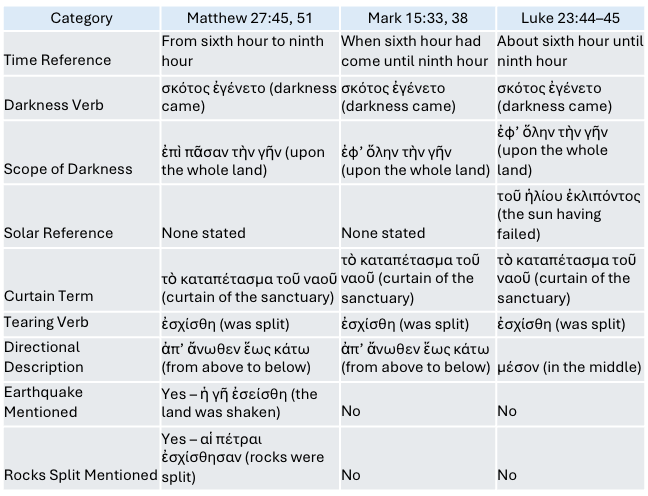
For the purposes of this article, the shared claim is clear: at the moment of Jesus’ death, the Temple veil was torn in two. In two of the three accounts, that tearing is explicitly described as occurring from above to below. The wording presents a physical event within a real structure.
Before meaning is explored, the physical nature of that structure must be understood.
III. The Veil as Structure, Not Symbol
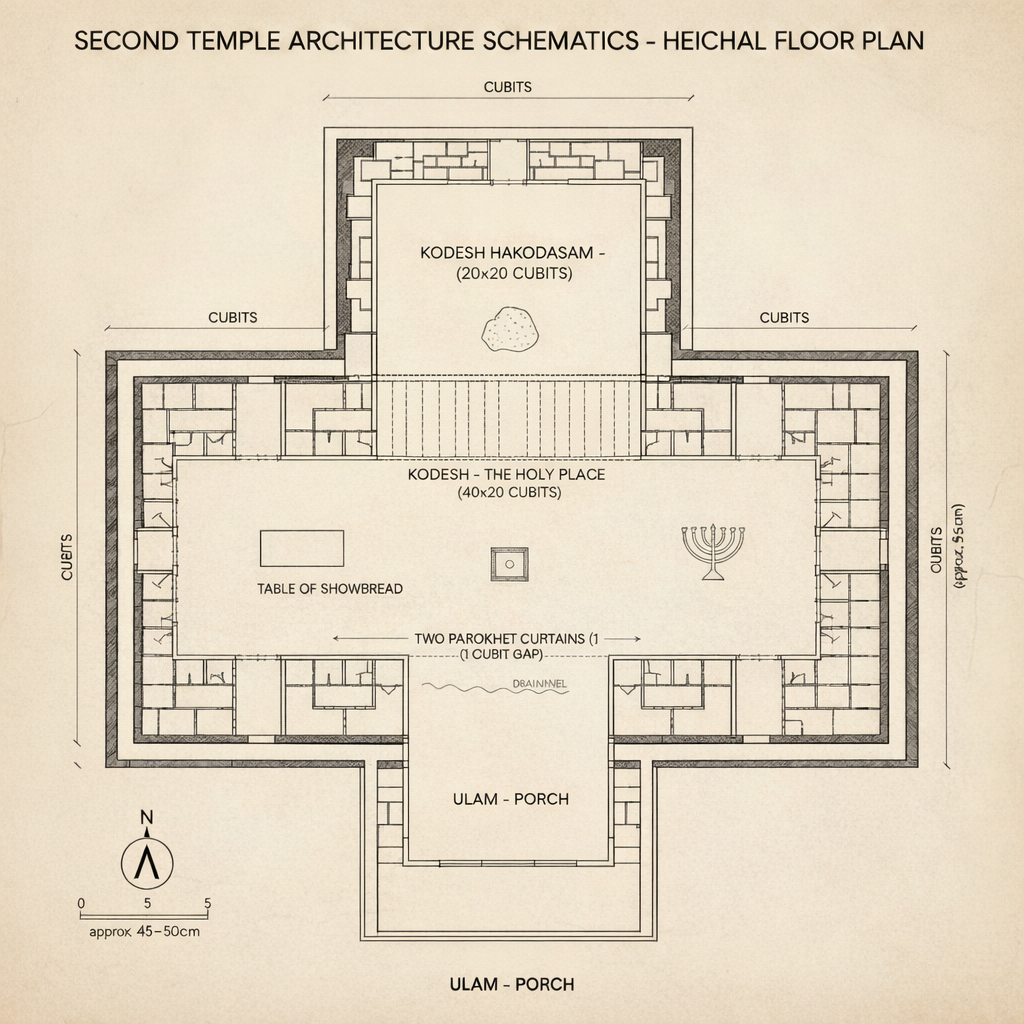
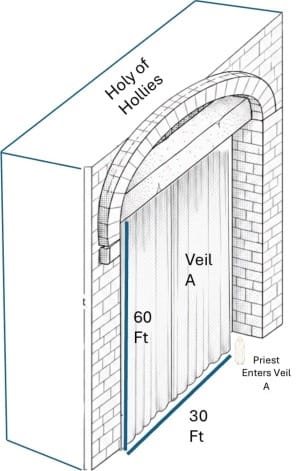
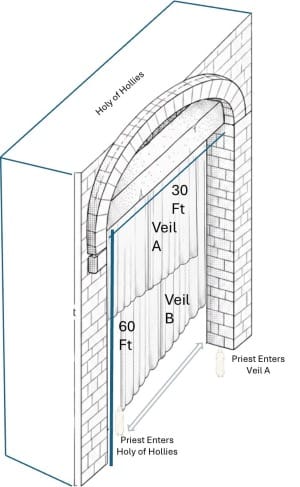
Before theological meaning is considered, the physical nature of the Temple veil must be examined. Mishnah Yoma 5:1 indicates that in the Second Temple there were two veils with a cubit of space between them, through which the High Priest passed on the Day of Atonement. A cubit in the late Second Temple period is commonly estimated at approximately 17.5 to 18 inches, so the space between the veils would have been roughly 1.5 feet. If this tradition accurately reflects Herod’s Temple, then at the time of Jesus’ death two massive textile barriers stood between the Holy Place and the Most Holy Place, arranged in offset alignment rather than as a single movable curtain. Josephus, writing in the first century, refers to a monumental veil separating the sanctuary spaces and describes its scale and embroidered design, though he speaks in the singular and does not explicitly mention a double-veil arrangement. It is therefore possible that contemporary language referred collectively to “the veil” even if two layers were present.
The Gospel accounts refer to the veil using the Greek term καταπέτασμα (katapétasma), meaning the inner curtain separating the Holy Place from the Most Holy Place. This was not a decorative feature. It functioned as a structural boundary within the Temple complex in Jerusalem.
No physical fragment of the Second Temple veil survives. Archaeological excavation on the Temple Mount is limited, and no textile remains from the inner sanctuary have been recovered. Our understanding of the veil’s construction therefore relies on literary sources; particularly rabbinic descriptions preserved in the Mishnah and later Talmudic traditions. These sources were compiled after the destruction of the Temple in AD 70 and must be treated cautiously. They are not engineering blueprints. Nevertheless, they provide consistent dimensional descriptions that are unlikely to be wholly invented.
Rabbinic sources describe each veil as forty cubits high and twenty cubits wide. The precise length of a cubit is debated, but using the 17.5 to 18 inch range, forty cubits would equal approximately 58 to 60 feet in height, and twenty cubits would equal approximately 29 to 30 feet in width. In practical terms, each veil would have stood nearly as tall as a six-story building and extended roughly the width of a small street.
The thickness is described as a handbreadth, generally estimated at about 3 to 4 inches. Whether this measurement was strictly literal or partially symbolic cannot be determined with certainty. However, if taken at face value, the description indicates a dense and substantial textile rather than a thin hanging drape.
Estimating weight requires careful qualification. We do not know the precise weave density, nor can we confirm that the full thickness was uniform throughout. Even so, if one assumes dimensions of approximately 60 feet by 30 feet and a thickness of 3 to 4 inches, conservative structural modeling yields substantial mass. Using reasonable density estimates for a tightly woven linen composite, the weight of a single veil could plausibly fall within a range of approximately 6 to 14 metric tons, or roughly 7 to 15 U.S. tons. This range depends on assumptions about material density and construction and should be understood as modeled rather than directly measured. Even under cautious assumptions, each veil would have weighed multiple tons rather than hundreds of pounds.
The material is described as fine linen interwoven with blue, purple, and scarlet threads, with cherubim woven into the fabric itself. This suggests a loom-woven textile of considerable complexity rather than layered fabric stitched together. The veils were not temporary installations. They were engineered to endure.
It is important not to exaggerate what cannot be confirmed. Some later rabbinic traditions describe extraordinary handling procedures or dramatic weight claims. Those details cannot be independently verified. Yet even without appealing to the most expansive descriptions, the dimensions alone indicate massive and imposing structures.
The veils functioned as suspended barriers. They hung vertically between two sacred chambers within the Temple building. Their role was restrictive. They marked the boundary beyond which only the High Priest could enter, and only once per year, on the Day of Atonement. They were not designed to be casually moved, frequently replaced, or easily penetrated. Access was achieved through offset positioning and narrow passage, not by drawing aside a curtain.
From a mechanical perspective, a textile approximately 60 feet tall, 30 feet wide, and several inches thick, suspended from above, would experience continuous tensile stress due to its own weight. The load would concentrate at the upper attachment points. Any rupture would likely originate where stress was greatest or where force was applied.
Would like to repeat that the Gospel writers use the term καταπέτασμα to refer specifically to the veil separating the Holy Place from the Most Holy Place, not the outer curtain at the entrance to the sanctuary. In the Temple hierarchy, this inner barrier marked the boundary of the Most Holy Place, the chamber associated in Jewish theology with the dwelling presence of God. Whether the Second Temple employed one veil or two layered veils as described in rabbinic tradition, the barrier in view is the one that stood between the priestly ministry and the innermost sacred space. It was this boundary, understood to restrict access to the divine presence, that is said to have been torn.
This context is essential. The Gospel description does not concern a fragile fabric panel. It concerns one or more massive structural textiles within a monumental stone building. If the veil was torn “from above to below,” as Matthew and Mark state, the tearing began near the suspension point.
Any attempt to evaluate the plausibility of the event must begin with the scale and structural reality of what is being described.
IV. Seismic Context and Historical Timing
Jerusalem lies within a tectonically active region shaped by the Dead Sea Transform fault system. This fault boundary runs along the Jordan Valley and through the Dead Sea basin and has produced numerous historical earthquakes. Ancient sources outside the New Testament attest to seismic activity in the broader region of Judea in various centuries. What cannot be showed with precision is whether a specific earthquake occurred in Jerusalem at the exact moment described in the Gospel narrative. That claim rests within the text itself.
Geological research provides relevant context. In 2011, geologist Jefferson B. Williams and colleagues analyzed laminated sediment cores from the western shore of the Dead Sea near Ein Gedi. These annual sediment layers, known as varves, preserve deformation patterns caused by seismic shaking. The researchers identified a disturbed layer interpreted as the result of a significant earthquake in the early first century. Based on their chronological reconstruction, the event was dated to approximately AD 31, with an uncertainty range of plus or minus five years. That range falls within the governorship of Pontius Pilate, traditionally dated from AD 26 to 36.
The existence of this paleoseismic disturbance does not establish that it corresponds to the earthquake mentioned in Gospel of Matthew 27:51. Sediment layers cannot be dated to a specific day. The chronological margin of error must be respected. What the research demonstrates is that the region was not geologically quiet during the period in which the crucifixion is traditionally placed.
Astronomical retrocalculations further indicate that a partial lunar eclipse occurred on April 3, AD 33, using the Julian calendar in effect at the time. That date corresponds with one widely supported reconstruction of the crucifixion chronology, which places the event during Passover in AD 33. While astronomical modeling can determine lunar phases with high precision, it cannot independently verify the historical occurrence of the crucifixion on that date. Nor can it confirm the specific darkness described in the Gospel accounts. Because Passover occurs at full moon, an ordinary solar eclipse is not a viable explanation for the midday darkness reported in the Synoptic Gospels. The nature of that darkness remains debated.
It is important to distinguish between correlation and causation. The geological evidence indicates that an earthquake occurred in the early first century within a time window that includes AD 33. The Gospel of Matthew reports seismic shaking at the time of Jesus’ death. The chronological overlap is notable. It is not proof of identity.
Historical context must also be considered. In the modern world, Jesus of Nazareth is widely recognized as one of the most influential figures in human history. Yet at the time of His execution, He held no political office and commanded no formal authority. He was a Galilean teacher operating under Roman occupation. To the Roman administration, His crucifixion would have appeared as one more provincial execution. To certain religious authorities in Jerusalem, He represented theological and social disruption. Outside Judea, His death likely passed without notice.
If seismic shaking occurred during that period, its geological imprint would exist independently of the later global significance of the individual being executed. The earth does not record events according to future influence. Any convergence between paleoseismic data and Gospel testimony must therefore be evaluated without retroactive amplification.
The question before us is not whether geology can confirm theology. It cannot. The narrower question is whether the physical record of the region permits the possibility that seismic forces were active during the timeframe in which the Gospels place the crucifixion. On that limited point, the answer is yes. Whether the specific disturbance identified in Dead Sea sediments corresponds to the event described in Matthew remains a matter of historical interpretation rather than demonstrable proof.
V. How Could the Veil Have Torn?
In Christian interpretation, the curtain understood to have been torn is the inner curtain separating the Holy Place from the Most Holy Place. The present analysis focuses on that inner veil.
If the veil measured approximately sixty feet in height and, according to later sources, weighed several tons, it could not have hung from a simple rod or ornamental fixture. It would have required substantial structural support integrated into the architecture of the sanctuary. The full gravitational load of the textile would have been borne at its upper attachment, most plausibly distributed across a structural beam or lintel spanning the entrance to the inner chamber. Whatever the precise mounting system, the essential mechanical fact remains: the entire mass of the veil was suspended from above.
That detail is decisive. A suspended structure behaves differently from a fixed panel. The weight of the veil would have produced continuous tensile stress along its upper edge. The fibers at the top would constantly bear the load of everything below them. In static conditions that load remains stable. Under sudden disturbance, it does not.
If the veil had been cut manually, the most accessible portions would have been those within human reach. A tear beginning at the bottom and propagating upward would be more consistent with direct intervention. The description, however, indicates that the rupture began “from above.” To initiate such a tear manually would have required access to the suspension framework high within the Temple interior, along with tools and time. The Gospel narratives describe no such activity, and the inner precincts of the sanctuary were not casually accessible. While deliberate action cannot be declared impossible, it does not align naturally with the directional detail preserved in the text.
Gradual material deterioration offers no stronger explanation. Textiles under sustained load do weaken over time, yet fatigue failure typically produces localized fraying or tearing at stress concentration points, not a sudden division “into two” synchronized with a specific historical moment. The Gospel writers present the tearing as coincident with the death of Jesus. That synchronization may carry theological weight, but narratively it is precise rather than progressive.
If neither deliberate intervention nor progressive deterioration sufficiently accounts for a top-initiated rupture, the remaining physical category is sudden structural disturbance. Matthew explicitly reports that the earth was shaken. An earthquake does not move a building as a single rigid block. Stone walls, beams, and structural elements respond with rapid differential motion. Even small displacements, measured in centimeters rather than meters, can alter tension within suspended components. If one portion of the upper support shifted slightly relative to another, the veil would experience uneven loading across its width.
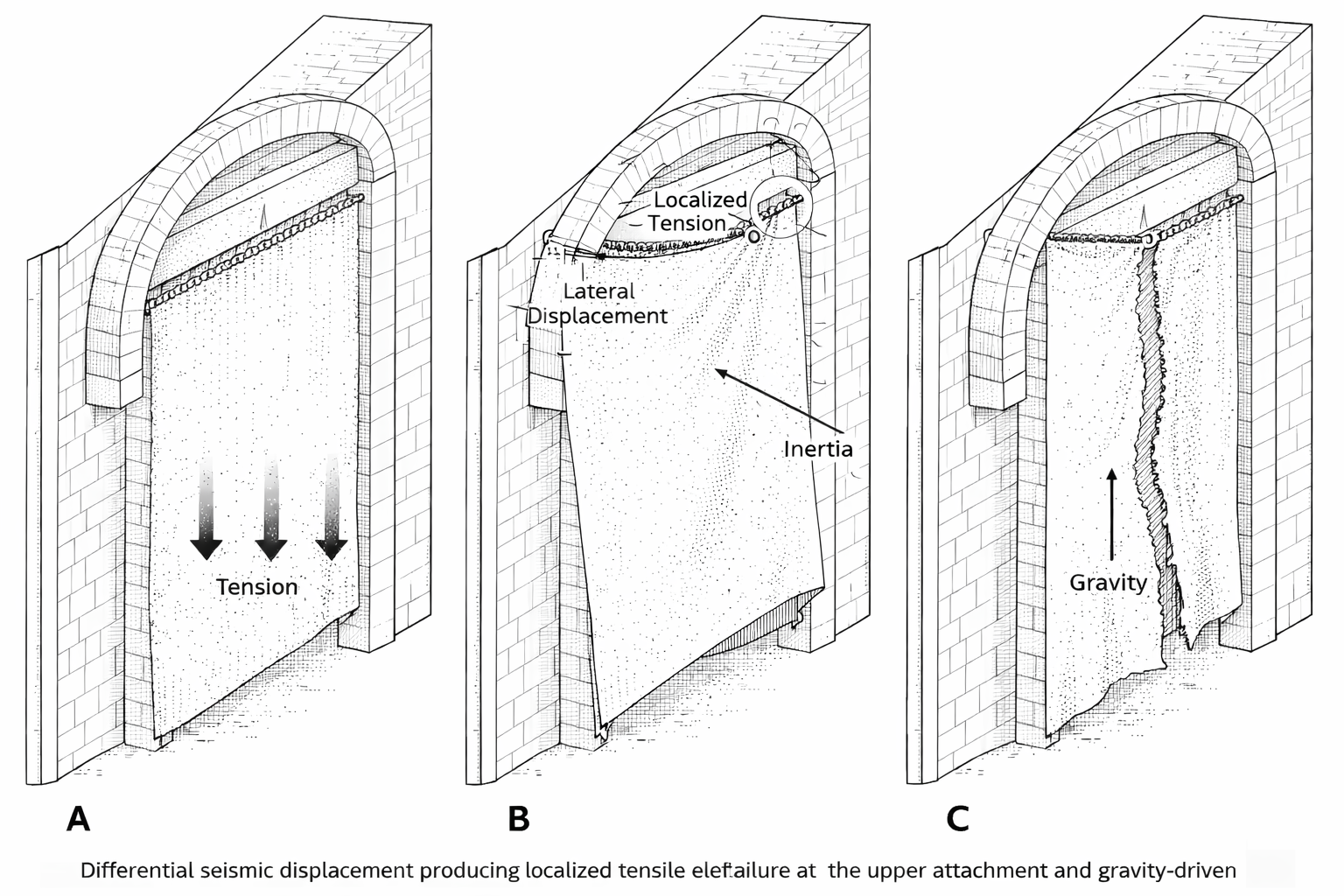
A heavy suspended textile behaves less like light fabric and more like a flexible structural membrane. Under lateral oscillation, inertia would cause the veil to lag behind the motion of its supports and then reverse as movement changed direction. If the upper attachment constrained free sliding, cyclic side to side displacement could concentrate tensile stress at a fixed point near the top, where the entire mass was already being carried. Once fibers at that location began to fail, gravity would amplify the rupture. The full weight of the veil hung beneath the point of failure. A tear initiated near the suspension point would not remain localized. Downward force would pull along the path of least resistance, and the rupture could propagate vertically. In such a scenario, a tear from above to below accords with how failure would propagate once initiated at the point of suspension.
Luke’s statement that the veil was torn in the middle is not inconsistent with Matthew and Mark. If opposing supports shifted during seismic motion, tensile stress could increase along the centerline. A centrally initiated tear at the top would divide the veil into two sections as the rupture descended, reflecting symmetrical stress release under lateral displacement.
It is also necessary to distinguish between static and dynamic loading. A structure stable under constant weight can fail under sudden impulse. Seismic impulse can momentarily elevate tensile stress beyond fiber capacity, even in a robust textile. The veil’s stability under ordinary conditions would not guarantee resilience under abrupt displacement.
Several uncertainties remain. The precise attachment method of the veil is not preserved. The magnitude, duration, and proximity of any early first-century earthquake affecting Jerusalem cannot be reconstructed with certainty. Geological evidence confirms regional seismic activity within a relevant timeframe, yet it cannot specify the structural response inside the Temple interior. The analysis therefore cannot provide a definitive reconstruction of the event. It can, however, establish a boundary condition. A large, suspended textile barrier subjected to differential seismic displacement could experience a rupture initiated at the top and propagated downward under its own weight. The description preserved in the Gospel accounts lies within the constraints imposed by structural mechanics and physical law.
VI. The Meaning of the Torn Veil
If the veil was torn at the moment of Jesus’ death, the event cannot be reduced to structural failure. It would have represented a rupture at the theological center of Israel’s worship.
In the Second Temple, the veil marked the boundary between the Holy Place and the Most Holy Place. Beyond it lay the innermost chamber, associated in Jewish theology with the presence of God. Entry beyond that veil was restricted. Only the High Priest could enter, and only once each year on the Day of Atonement. The veil was therefore not decorative. It embodied separation. It declared that access to the divine presence was mediated and guarded.
Its tearing, if known, would not have been interpreted lightly. Even apart from Christian interpretation, a rupture of the inner veil would have represented a disturbance at the symbolic heart of the Temple system. The boundary that defined sacred restriction had been breached.
Within Christian theology, the timing of the event is decisive. The tearing is recorded as occurring at the moment of Jesus’ death. It is not presented as an unrelated accident or later development. The sequence is intentional. The crucifixion and the tearing belong together.
The Epistle to the Hebrews interprets this imagery directly, speaking of access to the Holy Place through the death of Christ and describing a “new and living way.” In that theological framework, the veil represents the barrier created by sin, and its tearing signifies the completion of atonement. The sacrificial system, repeated year after year, pointed forward. The tearing of the veil signals that what it anticipated had been fulfilled.
This does not imply that holiness was diminished or that divine transcendence was removed. Rather, it proclaims that mediation through the Temple structure reached its intended culmination. Access to God was no longer confined to a hereditary priesthood operating within a specific architectural sanctuary.
For Jews of the first century who did not accept the Christian proclamation, such a claim would have been radical even heretic. The Temple stood at the center of covenant life. To assert that its innermost barrier had been rendered obsolete by the execution of a Galilean teacher would have been destabilizing.
For those who came to confess Jesus as Messiah, however, the torn veil became a defining sign. It declared that the separation symbolized for generations had ended. The boundary was not gently moved aside. It was torn. The language conveys finality. The event, as recorded, represents not merely an architectural rupture but a covenantal one. It announces that the separation symbolized by the veil had ended.
For centuries, that barrier had stood as a visible declaration of distance. Its tearing at the moment of the crucifixion signifies not the abandonment of holiness, but the fulfillment of what the Temple system anticipated. The sacrificial pattern reached its culmination. The boundary that once defined restricted access became the sign of completed reconciliation.
In this sense, the sign that shook the Temple reaches beyond stone and fabric. It concerns the relationship between God and humanity. The barrier that defined Israel’s worship was no longer standing. Access was opened, not through architecture, but through the death of the one Christians confess as Messiah.
VII. What We Cannot Verify
No fragment of the Second Temple veil survives. No physical textile remains from the inner sanctuary have been preserved, and no archaeological excavation has produced direct material evidence of its construction or condition at the time of the crucifixion.
No independent contemporaneous Roman or Jewish record explicitly confirms that the veil was torn at that moment. The account rests within the Gospel testimony itself. While early Christian writings affirm the event, no external administrative or architectural documentation survives that records structural damage within the Temple during that period.
The paleoseismic evidence from the Dead Sea indicates regional disturbance in the early first century, but it cannot identify a specific day or confirm structural effects inside the Temple. Geological data provide context, not verification.
If the veil was torn, priests ministering in the Holy Place would have discovered it promptly. Entry into the Most Holy Place was restricted, but daily priestly service occurred in the chamber immediately before the veil. Information within priestly circles in Jerusalem could have circulated rapidly, particularly during Passover when the city was full and tensions were high. The Book of Acts later records that many priests became obedient to the faith, making the transmission of such knowledge historically plausible. None of this can be demonstrated directly, but it removes the assumption that the event would have remained unknown to the early Christian community.
These limits must be acknowledged. Historical inquiry can assess plausibility. Engineering analysis can evaluate coherence. Neither can compel belief.
The tearing of the veil ultimately stands at the intersection of testimony and faith. Intellectual honesty does not diminish that claim. It clarifies its nature.
VIII. Conclusion: The Sign That Shook the Temple
The tearing of the Temple veil stands at the intersection of faith, history, and physical reality. The Gospel accounts present the event succinctly but concretely. A real structure in a real building is said to have been torn at a specific moment in time.
Historical inquiry cannot independently verify the event. No surviving textile remains. No contemporaneous Roman report confirms structural damage. Geological evidence from the Dead Sea indicates seismic activity in the early first century, but it cannot identify a specific day or confirm the local effects inside the Temple. These limits are real and must be acknowledged.
Yet the description preserved in the Gospels is not mechanically incoherent. A massive, suspended textile barrier, weighing multiple tons and supported from above, subjected to sudden structural displacement, could experience a rupture beginning at the top and propagating downward under its own weight. The narrative does not require suspension of physical law. It describes a failure mode consistent with known structural behavior.
The significance of the event, however, extends beyond mechanics. The veil symbolized separation, mediated access, and guarded holiness. Its tearing at the moment of the crucifixion represents, within Christian theology, the fulfillment of what that separation signified. The barrier was not gradually removed. It was torn. The language conveys decisiveness.
At the time of Jesus’ death, He was not recognized as a world figure. He was a Galilean teacher executed under Roman authority. Yet the sign associated with that death, as recorded in the Gospels, speaks not merely of fabric and stone but of covenant and access. The boundary at the center of Israel’s worship was declared open.
The sign that shook the Temple was therefore more than seismic disturbance. It marked a transition in how the relationship between God and humanity was understood. Whether one receives that claim in faith or examines it historically, its magnitude cannot be dismissed. The tearing of the veil remains one of the most symbolically charged moments in the crucifixion narrative.
Faith does not depend on engineering. But neither does engineering contradict the Gospels.
Sources and Acknowledgments
The Gospel accounts examined in this article are drawn from the Greek New Testament, Nestle-Aland 28th edition, with reference to the Synoptic narratives in Matthew 27:45–51, Mark 15:33–38, and Luke 23:44–45, as well as the theological interpretation found in Hebrews 9–10.
Descriptions of the dimensions and construction of the Second Temple veil are derived primarily from rabbinic sources, including the Mishnah, tractates Yoma and Middot, and later Talmudic discussion. These sources were compiled after the destruction of the Temple in AD 70 and reflect preserved tradition rather than contemporary engineering documentation. Their dimensional descriptions are therefore treated cautiously and used as approximate indicators rather than precise measurements.
Discussion of early first-century seismic activity in the Dead Sea region draws upon the work of Jefferson B. Williams, Markus J. Schwab, and Achim Brauer, whose paleoseismic analysis of laminated Dead Sea sediments identifies a regional disturbance dated approximately AD 31, with an uncertainty range of several years. This geological research provides contextual evidence of regional seismic activity but does not independently confirm the specific event described in the Gospel of Matthew.
Astronomical references concerning the partial lunar eclipse of April 3, AD 33 (Julian calendar), are based on modern retrocalculations provided by NASA’s lunar eclipse catalog and related astronomical scholarship. Such data confirm celestial conditions but cannot independently establish the date of the crucifixion.
All structural modeling presented in this article, including weight estimates for the Temple veil, is derived from dimensional assumptions combined with modern engineering principles governing tensile stress and dynamic loading in suspended textile structures. These calculations are modeled approximations intended to evaluate mechanical plausibility rather than to reconstruct exact historical specifications.
This article distinguishes clearly between what can be verified, what can be reasonably modeled, and what ultimately rests in theological conviction. Intellectual honesty does not weaken the claim. It clarifies its scope.
Selected References
Humphreys, Colin J., and W. G. Waddington. “Dating the Crucifixion.” Nature 306 (1983): 743–746.
Mishnah. Tractates Yoma and Middot.
Nestle-Aland. Novum Testamentum Graece, 28th ed. Stuttgart: Deutsche Bibelgesellschaft, 2012.
NASA Jet Propulsion Laboratory. Lunar Eclipse Catalog.
Williams, Jefferson B., Markus J. Schwab, and Achim Brauer. “An Early First-Century Earthquake in the Dead Sea.” International Geology Review 54, no. 10 (2012): 1219–1228.
Josephus War 5.5.4 or Antiquities 15.11
Appendix A: Veil Weight Estimate, Assumptions and Calculation
This article includes a modeled weight range for the Second Temple veil. No physical textile survives, and no ancient engineering record provides an exact mass. The estimate below is therefore a mechanical approximation based on dimensional descriptions preserved in later rabbinic sources, combined with conservative material assumptions. The purpose is not to establish an exact weight but to show that, if the reported dimensions and thickness are taken literally, the structure would have been measured in tons.
A.1 Dimensional Assumptions
Rabbinic descriptions commonly describe the veil as forty cubits high and twenty cubits wide. The cubit length in the late Second Temple period is debated. A typical estimate is 17.5 to 18 inches per cubit.
Using that range:
- Height: 40 cubits × 17.5–18 in = 700–720 in
= 58.3–60.0 ft
- Width: 20 cubits × 17.5–18 in = 350–360 in
= 29.2–30.0 ft
For modeling, this appendix uses:
- Height ≈ 60 ft (18.29 m)
- Width ≈ 30 ft (9.14 m)
Thickness is described as a handbreadth. A handbreadth is commonly estimated at 3 to 4 inches. For modeling, this appendix uses:
- Thickness ≈ 3–4 in (0.0762–0.1016 m)
A.2 Volume Calculation
Volume = Height × Width × Thickness
Using meters:
- Height: 18.29 m
- Width: 9.14 m
At 3 inches thick (0.0762 m):
Volume ≈ 18.29 × 9.14 × 0.0762
Volume ≈ 12.7 m³
At 4 inches thick (0.1016 m):
Volume ≈ 18.29 × 9.14 × 0.1016
Volume ≈ 17.0 m³
A.3 Density Assumption
Solid linen fiber has a high intrinsic density, but a woven textile contains significant air volume. The effective bulk density depends on weave tightness, layering, and construction. Since the veil is described as unusually thick and structurally substantial, a conservative bulk-density range is used:
- Bulk density ≈ 500–800 kg/m³
This range is not a historical claim. It is a modeling choice intended to avoid unrealistic extremes.
A.4 Mass Calculation
Mass = Volume × Density
Lower bound:
12.7 m³ × 500 kg/m³ ≈ 6,350 kg
≈ 6.35 metric tons
≈ 7.0 U.S. tons
Upper bound:
17.0 m³ × 800 kg/m³ ≈ 13,600 kg
≈ 13.6 metric tons
≈ 15.0 U.S. tons
A.5 Modeled Range
Under these assumptions, the veil’s mass plausibly falls within:
- Approximately 6 to 14 metric tons
- Approximately 7 to 15 U.S. tons
A.6 Limitations
This estimate depends on assumptions that cannot be independently verified:
- The exact cubit length used in the original description
- Whether “handbreadth” thickness is literal or rhetorical
- Whether thickness was uniform across the entire veil
- The veil’s true construction method and bulk density
The calculation is therefore best understood as an order-of-magnitude model. Even if thickness or density is reduced substantially, the resulting weight remains large enough to support the article’s core point: the veil, as described, was not a light curtain but a massive, suspended structure.