The Tale of Three Lasagna: Why Semantic Architecture Matters
We assume words carry meaning. They do not. Meaning emerges from the concepts, assumptions, and context behind them. When those differ, the same word can produce entirely different realities.
By Edward Miranda - July 20, 2026
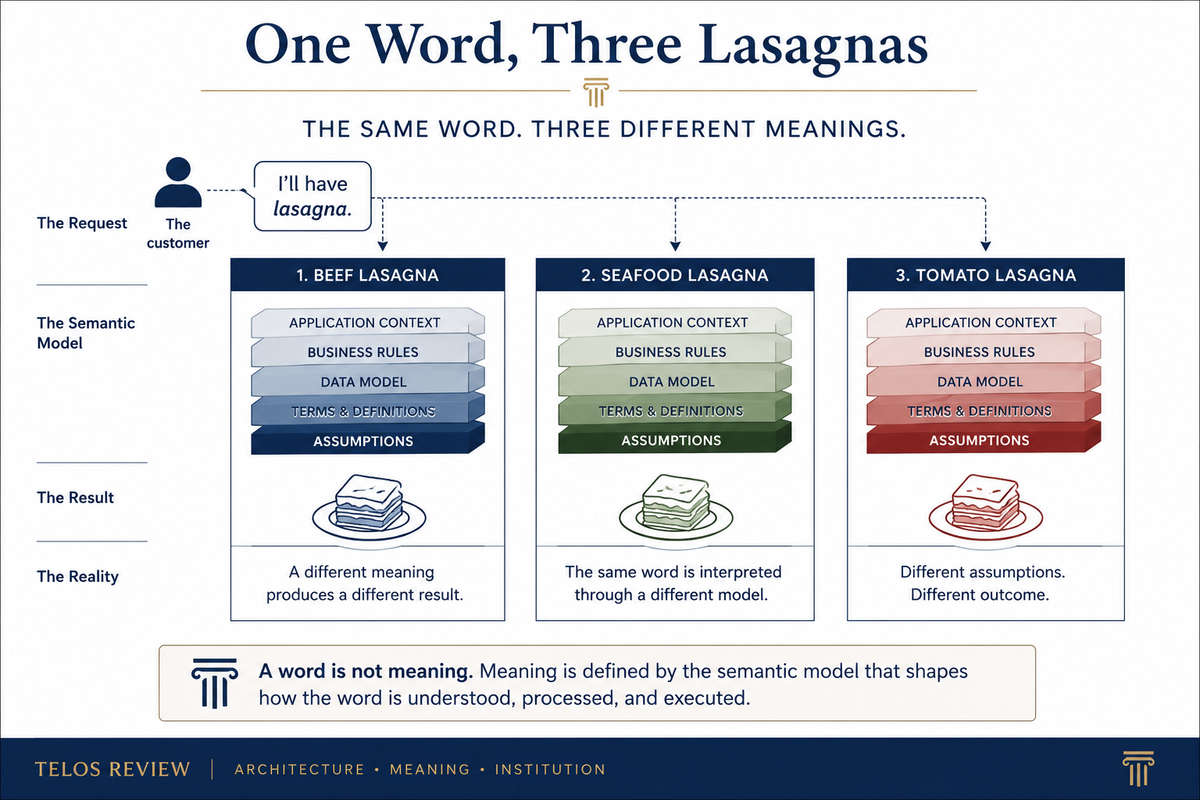
At first glance, this video appears to be about a simple restaurant order. A customer asks for lasagna. The request seems straightforward. Everyone believes they understand exactly what was requested.
But do they?
Behind that single word may exist multiple interpretations, each perfectly valid within its own context. The customer assumes everyone shares the same meaning, while the people preparing the order operate according to entirely different definitions.
This simple story illustrates one of the most persistent challenges in modern enterprises: words do not carry meaning by themselves. They acquire meaning from the semantic models, business rules, and contextual assumptions that surround them.
Banks, insurers, healthcare providers, governments, and nearly every large organization struggle with this problem every day. Systems exchange identical terms while silently assigning them different meanings, creating inconsistency, reconciliation costs, and operational confusion. The issue is rarely the data itself. More often, it is the meaning attached to that data.
This short video uses a familiar example to demonstrate why semantic consistency matters, why shared vocabulary is not enough, and why enterprise architecture must ultimately concern itself not only with moving data but also with governing meaning.
Sometimes the most profound architectural lessons begin with something as ordinary as ordering lasagna.