The Invisible Market Controlling Bitcoin: Part I: The Synthetic System Beneath the Price
Part 1 - Bitcoin’s short-term price is shaped less by sentiment than by synthetic markets and strategic conflict among large participants. When these battles resolve, strategies fail, capital is redistributed, and participants disappear, leaving a thinner market governed by consequences, not intent.

By Edward Miranda - November 2025
Introduction: The Myth of Retail Bitcoin Pricing
Bitcoin’s price often moves sharply without any visible cause. There is no surge of retail buying, no wave of panic selling, no headline capable of explaining the shift. Yet the chart moves anyway. Observers look for explanations and find none. The familiar supply-and-demand story breaks down, leaving even experienced participants uncertain about what they are actually witnessing.
This confusion is not the result of randomness or irrational behavior. It exists because most observers are looking at the wrong market. Bitcoin no longer trades primarily as a simple exchange of coins between buyers and sellers. Its short-term price is increasingly shaped by a synthetic financial layer that operates at a scale, speed, and level of abstraction far removed from human decision-making. Until that structure is understood, Bitcoin’s price movements will continue to appear sudden, exaggerated, and disconnected from visible events.
Why Retail Activity No Longer Drives the Market
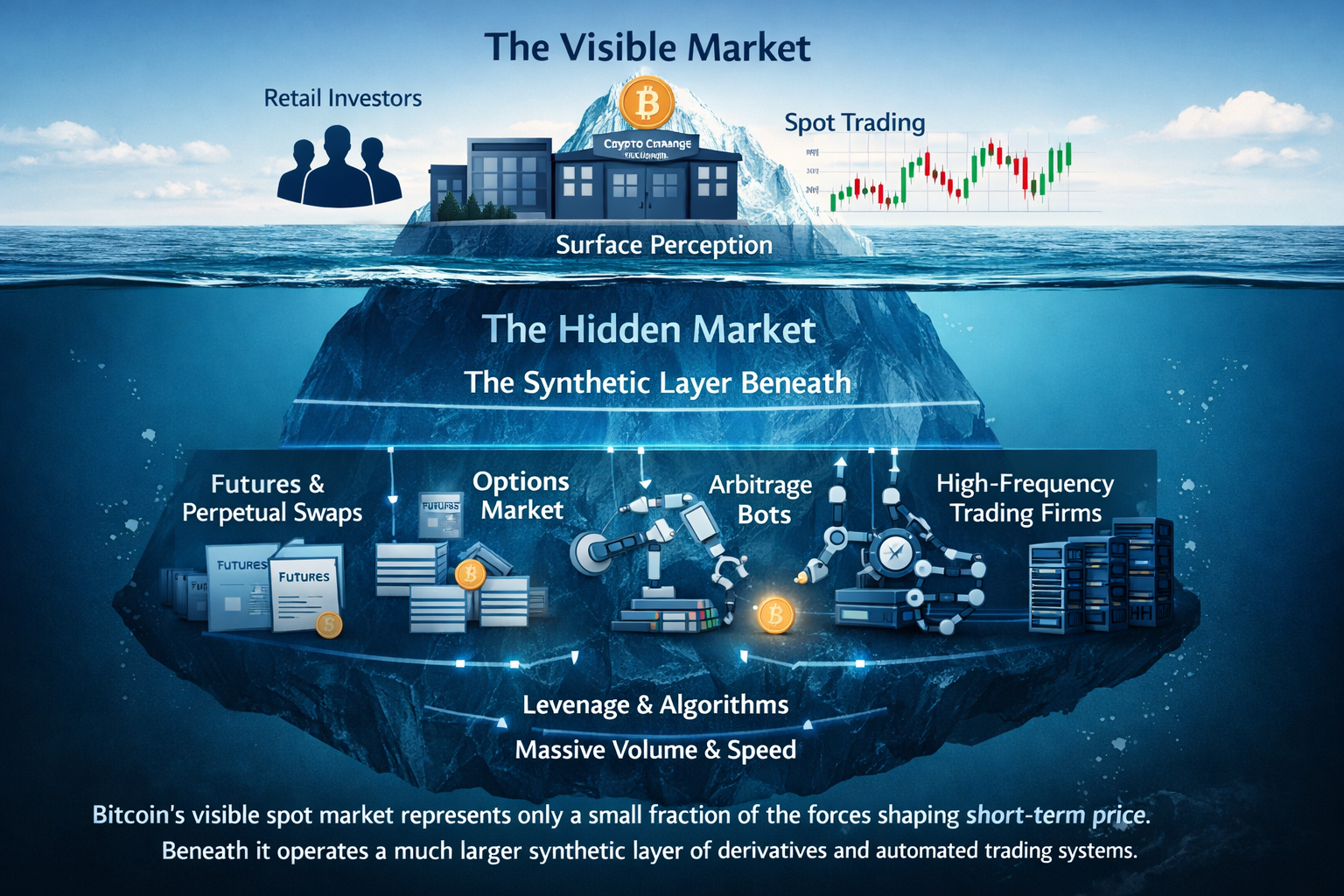
In reality, retail buying and selling plays almost no role in Bitcoin’s short‑term direction. The belief that individual investors drive the chart is almost entirely false. Bitcoin does not rise because thousands of people bought small amounts on an app. It does not fall because long‑term holders suddenly panicked. The price is now shaped by a much larger synthetic system that operates at speeds and scales far beyond human behavior.
The Rise of the Synthetic Bitcoin System
This synthetic layer includes futures, perpetual swaps, options, and automated arbitrage systems that transact enormous amounts of artificial Bitcoin. These contracts do not involve real coins held in wallets. They exist only as financial instruments on exchanges. They can be created in unlimited quantities. Yet they are the primary force behind the price that everyone sees on their screens.
Machine‑Driven Markets
Inside this synthetic world the dominant players are not individuals. They are institutions, hedge funds, proprietary trading firms, and high‑speed algorithms. These systems move billions of dollars in seconds. They react to microscopic price differences across exchanges. They hedge and unhedge positions in real time. They operate on signals and liquidity flows that no retail trader ever sees. When these systems move, the price moves. When they reverse, the price reverses. Retail traders do not create these shifts. They only witness them.
Why the Traditional View Fails
The misunderstanding comes from assuming that most of Bitcoin’s trading volume involves real coins changing hands. It does not. The overwhelming majority of activity involves synthetic contracts that behave like Bitcoin but are not Bitcoin. These contracts settle in cash, can be created instantly, and have no supply limit. They can produce ten times or fifty times the daily volume of real Bitcoin without touching the actual supply. Once you understand this, the traditional picture of a retail‑driven market collapses entirely.
Purpose of This Article
The purpose of this article is to make these mechanisms clear. It will show why the price moves even when real holders are not selling. It will explain the relationship between futures and spot markets. It will show how arbitrage bots enforce price alignment. It will reveal how whales move the market even without selling real Bitcoin. Most importantly, it will show that the short‑term direction of Bitcoin comes not from retail demand but from synthetic liquidity.
If this feels surprising, keep going. Once you understand the structure beneath the surface, the mystery disappears. The market becomes clearer, the movements make sense, and the short‑term noise finally reveals its underlying logic.
Difference Between Real Bitcoin and Synthetic Bitcoin
Most Bitcoin Trading Is Not Real Bitcoin
Most people who follow Bitcoin believe they are watching a market where real coins move between real buyers and real sellers. They assume the price shown on an exchange reflects the combined decisions of millions of people trading actual Bitcoin. This assumption feels natural because the trading screen presents a simple picture where price and volume appear to come from human activity. Yet the surprising truth is that most of the Bitcoin that appears to move across markets is not real Bitcoin at all. It is a collection of synthetic instruments that behave like Bitcoin but do not involve any actual coins.
The Apple Analogy
To understand this difference, imagine a market where people buy and sell apples. If buyers want more apples the price rises. If growers produce too many apples the price falls. Everything in this market reflects real fruit.
Now imagine a second market where traders buy and sell contracts that represent apples, but no physical apples change hands. These contract-apples can be created instantly and in unlimited quantities. They can be traded without ever touching a real apple. Traders can take positions equal to thousands of apples even if they do not own a single real apple. When this second market becomes larger than the real fruit market, the price everyone sees begins to reflect the contracts rather than the apples themselves.
Bitcoin Works Like the Contract Market
Bitcoin today operates much more like this second market. Real Bitcoin on the blockchain is slow. It lives in wallets. It is held long term. Most of it never enters exchanges. Only a small amount circulates in daily trading.
The synthetic Bitcoin market is entirely different. It is enormous, fast, and can expand without limit. It includes futures, perpetual swaps, options, and other leveraged instruments. These synthetic contracts do not involve real coins. They exist only as entries in exchange ledgers, and they can be created at will. This synthetic layer has become the dominant force behind Bitcoin’s daily price movement.
A Clear Example: How Synthetic Markets Force Real Bitcoin to Move
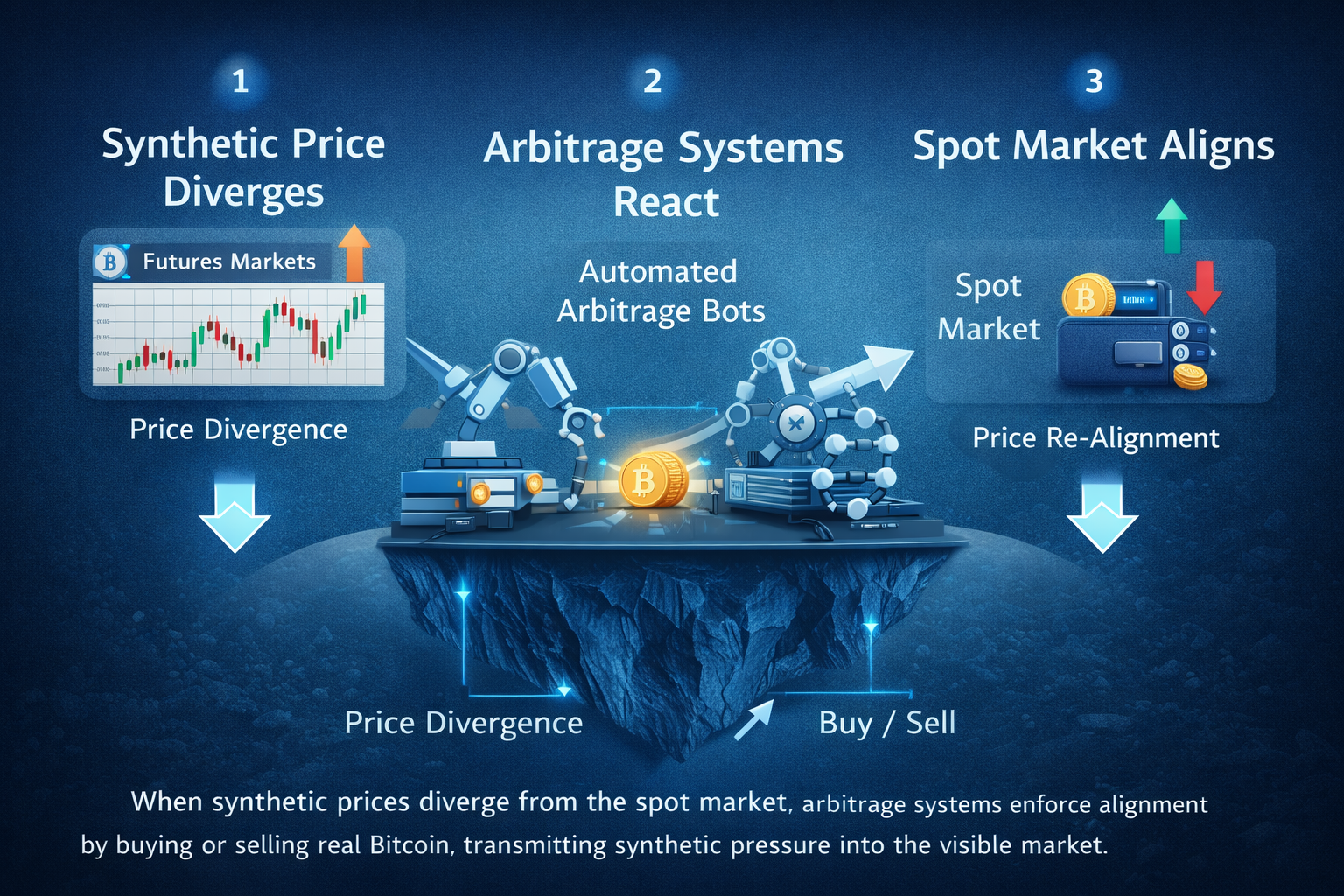
Many people ask how something that is not real Bitcoin can move the price of real Bitcoin. The answer becomes obvious through a simple example.
Step 1: Bitcoin trades at 85,000 dollars on a spot exchange.
Step 2: A whale sells a massive amount of synthetic Bitcoin on a futures exchange. No real coins are involved.
Step 3: Heavy synthetic selling pushes futures down to 84,700 dollars.
Step 4: A 300-dollar price gap now exists between spot and futures. Arbitrage bots detect a risk-free profit.
Step 5: Bots instantly sell real Bitcoin on the spot exchange at 85,000 and buy synthetic Bitcoin on the futures exchange at 84,700.
Step 6: By completing both trades, bots lock in a 300-dollar guaranteed profit per Bitcoin.
This sequence reveals a critical truth: bots must sell real Bitcoin to capture the profit. The spot market falls not because actual investors changed their minds, but because synthetic activity created a price gap and machines immediately exploited it. This is the mechanism that allows synthetic markets to pull the real market with them.
Why This Mechanism Matters
Once you understand this dynamic, the entire Bitcoin market becomes easier to interpret. Synthetic selling can push futures lower, which forces arbitrage bots to sell spot Bitcoin to realign prices. The same process works in reverse when futures move above spot.
These interactions happen across exchanges constantly, often in milliseconds. Machines monitor price differences and enforce alignment with extreme speed, which means most of the volume visible on screens reflects automated arbitrage rather than human decisions.
Synthetic Bitcoin Dominates Short-Term Price Movement
Synthetic Bitcoin may seem abstract because it consists of contracts rather than coins. Yet once you see that futures, perpetual swaps, and other leveraged instruments dominate daily activity, the behavior of the price becomes far more logical.
These synthetic tools allow huge positions to be opened or closed instantly. They offer far more leverage than traditional assets. They react to market changes faster than any human trader. As a result, synthetic flows drive short-term price direction, while real Bitcoin influences the market over much longer time frames.
Real Bitcoin cannot be created. It must move through the blockchain or exchange wallets. Synthetic Bitcoin, however, can be created or unwound instantly. This difference in speed and scale allows synthetic volume to overwhelm real spot activity.
Why Understanding This Difference Is Essential
Understanding the difference between real Bitcoin and synthetic Bitcoin is essential for interpreting the market correctly. Without this distinction, it is easy to assume that price movements reflect retail excitement or panic. Once the distinction becomes clear, the market becomes more predictable.
The true short-term drivers are synthetic contracts traded by institutions and high-speed systems. These instruments influence the spot market through arbitrage. They shape short-term price direction. They explain sudden, seemingly irrational movements. They form the hidden structure behind the price that most people never see.
How Synthetic Bitcoin Mirrors the Distortions That Caused Past Financial Crises
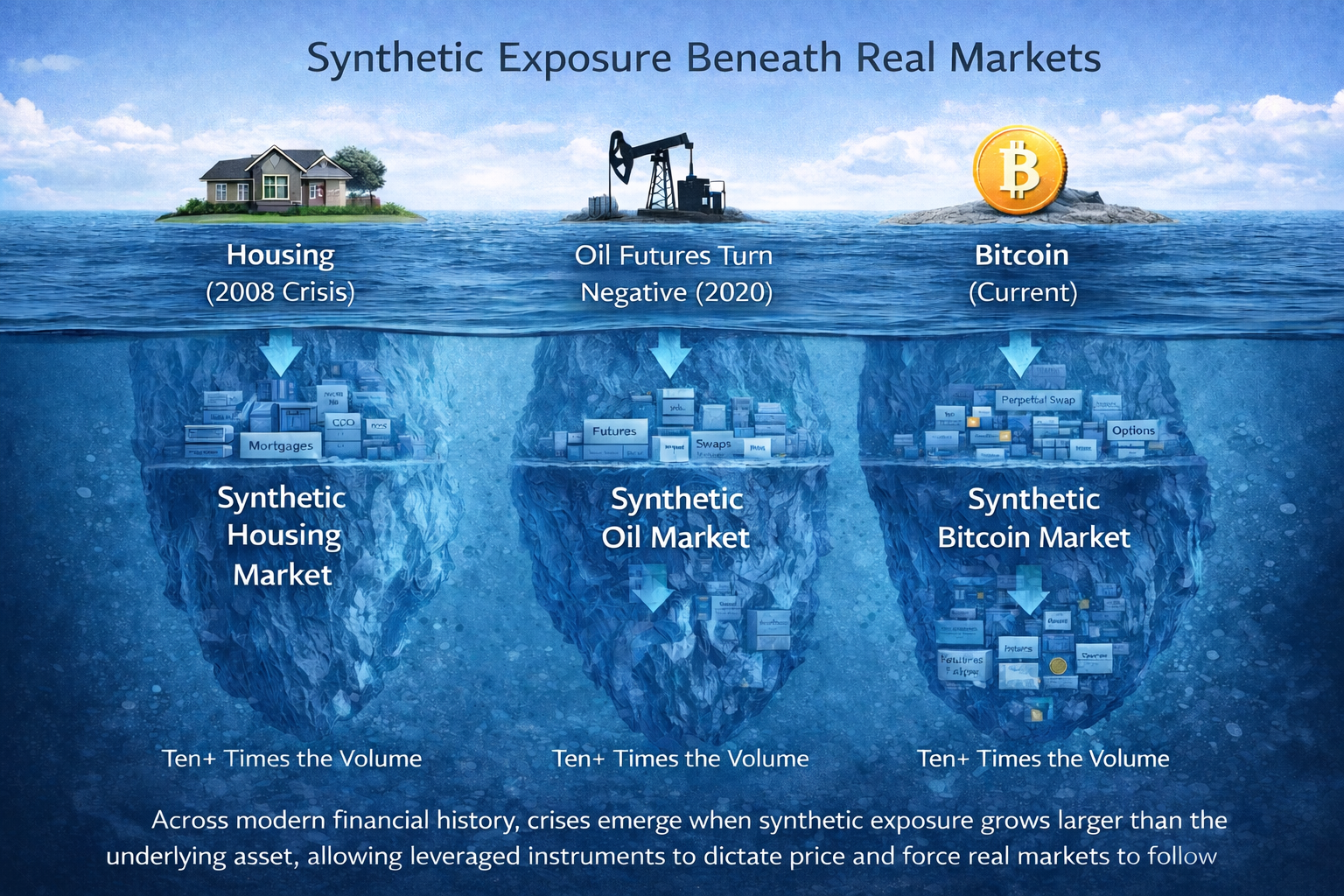
The Pattern: When Synthetic Markets Outgrow Real Markets
One of the most important insights for understanding Bitcoin’s behavior is that its synthetic market is not unique. The structure you see today in Bitcoin is part of a recurring pattern that has appeared in traditional finance for decades. It begins whenever a real asset with limited supply becomes surrounded by synthetic instruments that can be created in unlimited quantities. Once this happens, the synthetic market grows larger than the real market and begins to dictate the price of the underlying asset. This dynamic has driven some of the most significant financial disruptions in modern history. Bitcoin is simply the latest example of a familiar pattern.
The 2008 Crisis: Synthetic Leverage Swallows the Real Housing Market
In the years leading up to the 2008 financial crisis, the real housing market was relatively stable. People lived in their homes, mortgages were issued, and payments were made. The instability did not come from the houses themselves. It came from synthetic instruments that multiplied mortgage exposure far beyond the size of the real housing market.
Mortgage-backed securities, collateralized debt obligations, and credit default swaps allowed financial institutions to create layers of exposure that had no physical counterpart. When these synthetic positions began to unwind, they produced forced selling and cascading losses that the real market was too small to absorb.
The result was a synthetic collapse dragging down a real asset.
The LTCM Collapse (1998): Synthetic Leverage Amplifies Small Differences
A similar pattern emerged in 1998 with the collapse of Long-Term Capital Management. The real bonds and stocks in the fund’s portfolio did not experience extreme changes in value. The crisis came from the enormous synthetic leverage LTCM used to amplify tiny discrepancies between global markets.
The fund’s derivatives and highly leveraged positions multiplied the impact of relatively small price movements. When those synthetic positions moved against it, the losses grew large enough to threaten the global financial system. The synthetic exposure, not the underlying assets, created the danger.
Oil Goes Negative in 2020: A Synthetic Market Breaks From Reality
Another example appeared in 2020 when oil futures briefly traded at negative prices. The world did not run out of storage overnight. Oil wells did not suddenly produce infinite supply. The physical oil market remained intact.
The distortion came from synthetic contracts that required physical delivery at a time when storage capacity was already constrained. Traders holding these contracts faced obligations they could not meet. The synthetic market had become so large and so detached from physical conditions that its movements no longer reflected real-world supply and demand.
This was a purely synthetic collapse.
Bitcoin Fits the Same Historical Pattern
Bitcoin today mirrors this same structure. Real Bitcoin is scarce and stable. It exists on the blockchain, moves slowly, and has a fixed supply. Synthetic Bitcoin, by contrast, is abundant and highly leveraged. It exists in the form of futures, perpetual swaps, and options that can be created in unlimited quantities.
When synthetic positions build up, arbitrage forces the real market to move with them. The daily volatility many people blame on retail panic is often nothing more than the ripple effect of synthetic imbalances being unwound or recalibrated by automated systems.
Seeing Bitcoin Through the Synthetic Lens
Recognizing that Bitcoin’s synthetic market mirrors past financial distortions helps clarify what you are seeing. You are not witnessing a failure of Bitcoin itself. You are seeing the same financial dynamic that has appeared repeatedly in modern markets:
· synthetic instruments outgrow the real asset
· leverage multiplies exposure
· synthetic flows dictate price
· the real market is pulled along
The synthetic tail begins to wag the real dog.
Bitcoin follows the same rules. Its market follows the logic of synthetic speculation. Understanding that distinction is key to understanding Bitcoin’s short-term behavior.
In Part 2 we will explore the forces that enforce this synthetic system, including arbitrage bots and whales who move Bitcoin’s price without touching real coins. Understanding these players makes the market far more predictable and reveals the true engines behind short‑term Bitcoin movement.
Disclosures:
This article draws on well-established mechanisms in modern derivatives markets and historical financial crises.
Disclaimer: The views and opinions expressed in this article are solely those of the author and do not necessarily reflect the views of any employer or affiliated organization.