Causality, Intelligibility, and the Created Order
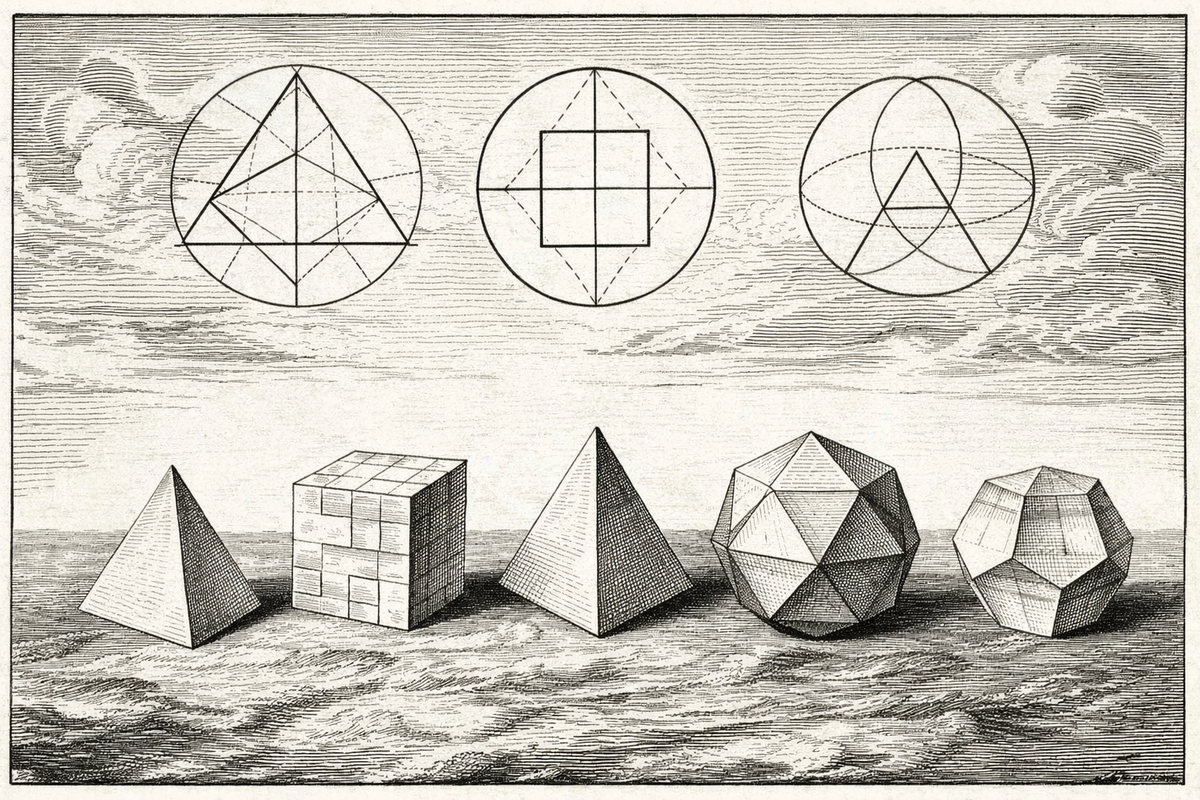
Speculative physics and science fiction alike have long imagined entities that move faster than light. Such hypothetical particles, often referred to as tachyons, are not merely faster travelers within space.
Their existence would collapse the distinction between cause and effect itself. Information could arrive before it was sent. Events could be known before they occurred. Consequence would lose its anchor in sequence.
What makes such scenarios unsettling is not their strangeness, but their incoherence. A universe in which effects precede causes would not simply behave differently. It would be unintelligible. Decision would detach from outcome. Meaning would fracture because meaning itself presupposes order.
For this reason, physics does not treat faster-than-light influence as a harmless speculation. Modern physical theories are constructed to forbid it, not by convention, but by necessity.
Without causal order, observation collapses, measurement loses significance, and explanation becomes circular. Causality is not a preference of physics. It is a condition for physics to exist at all.
At the same time, classical Christian theology has long insisted that causality is not ultimate. God is not bound by time, sequence, or succession. Past, present, and future are not distinct moments for God, but equally present to divine knowledge.
What would be catastrophic within the created order poses no difficulty for the Creator because time itself is part of what is created. This contrast reveals a fundamental truth. Causality is indispensable for creatures precisely because it is not absolute. It governs finite existence so that life may be intelligible, moral, and meaningful. It does not govern God.
Understanding why this is so requires attending carefully to the nature of time, the structure of causation, and the unexpected harmony between theology and modern physics.
Human experience unfolds through causality. We decide, we act, consequences follow. Intention precedes motion. Motion precedes outcome. Meaning itself depends on this order. Without causality, explanation collapses, responsibility dissolves, and choice becomes incoherent. For beings who live within time, causality is not merely useful. It is indispensable.
Language itself presupposes causality. Words unfold in sequence. Sentences derive meaning from order rather than mere content. A statement is intelligible because its beginning constrains its end, and its conclusion depends upon what preceded it. Grammar is not decorative. It encodes temporal and causal structure. Subject precedes predicate. Action follows intention. Narrative depends upon irreversibility, because a story in which events may be reordered arbitrarily ceases to be a story at all.
This dependence extends beyond spoken language to thought itself. To reason is to move from premise to conclusion. To explain is to trace an effect back to its cause. To understand is to situate an event within a sequence that makes sense of it. If causality were suspended, language would not merely lose precision. It would lose reference. Sounds might still be uttered, but meaning would dissolve, because meaning requires stability across time. That human language mirrors the causal structure of the world is not accidental. Language evolved to describe a reality that behaves consistently. Its success depends upon that consistency. A world without dependable causality would be not only uninhabitable, but unspeakable.
This dependence is so complete that causality often appears metaphysically inevitable. Human language presumes sequence. Memory presumes fixity. Responsibility presumes irreversibility. Hope presumes an open future. We struggle even to imagine existence without consequence or order. Yet necessity for experience does not imply ultimacy in reality. Causality governs how events unfold for finite creatures who exist within time. It does not follow that causality defines being itself.
God exists beyond time and sequence. God does not move from past to present to future. All moments are equally present to divine knowledge. From this standpoint, causality cannot be a property of ultimate reality. It must instead be a law instantiated within creation, binding finite beings to order so that life can be intelligible, moral, and meaningful. Causality is not what God obeys. It is what His creation requires.
This distinction is not speculative. It stands at the center of classical Christian theology and is unexpectedly reinforced by modern physics and philosophy. Theology and science do not compete here. They converge.
To see why causality must govern creatures but not God, the nature of time itself must be examined.
Augustine of Hippo and the Created Nature of Time
Augustine of Hippo was explicit that time itself is a created reality. In Confessions, Book XI, he confronts the question of what God was doing before creation and rejects it as incoherent. There was no “before.” Time itself begins with creation. To ask what precedes time is to misuse temporal language outside its proper domain.
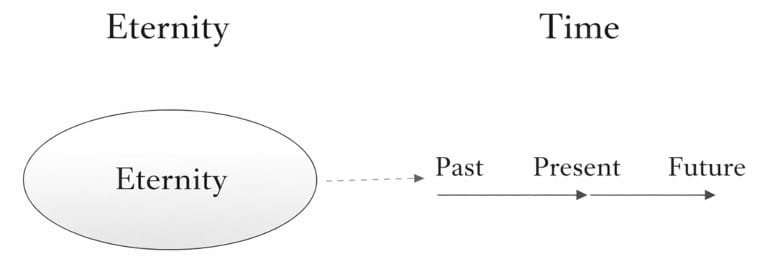
For Augustine, eternity is not infinite duration. Eternity is the absence of duration altogether. God does not experience a succession of moments. God exists in a single, unchanging present. Past and future are not features of divine life. They are features of creaturely existence.
Human beings cannot endure the unmediated presence of God not because of moral guilt alone, but because created, causal, temporal existence cannot survive direct exposure to uncreated, timeless being. The Incarnation is not God reduced, but God assuming a created mode of presence so that communion with creation becomes possible without collapse.
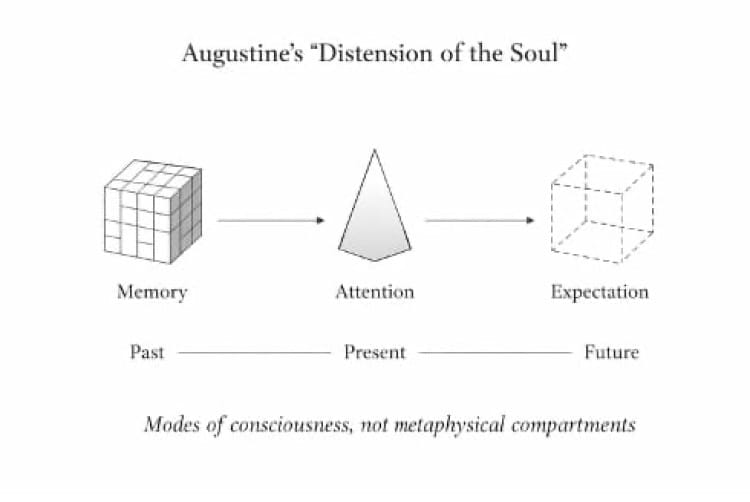
Augustine’s analysis of human time-consciousness deepens this insight. Human beings experience time through what he famously calls the distension of the soul. The soul is stretched between memory and expectation. There is the present of the past, which is memory. There is the present of the present, which is attention. There is the present of the future, which is expectation. Past and future exist only as modes of consciousness within the present.
This structure explains why causality is indispensable for human life. Memory presupposes a fixed past. Expectation presupposes an unresolved future. Attention presupposes sequence. Without causal order, identity fragments and experience loses coherence. A life without causality would not be liberated. It would be unintelligible even to itself.
God, however, does not remember or anticipate. God simply knows. Divine knowledge does not unfold through sequence. God comprehends all moments simultaneously. God does not foresee the future as creatures do. God comprehends the entire temporal order in a single, timeless act of knowing.
Under Augustine’s framework, causality belongs to becoming, not being. It governs change, not completion. It structures the journey of finite creatures toward ends they do not yet possess. Eternity, by contrast, is fullness without succession
Thomas Aquinas and the Structure of Causation
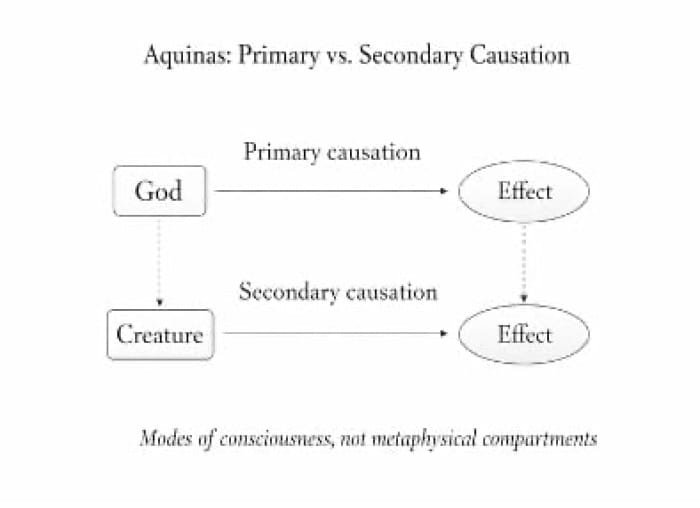
Thomas Aquinas refines Augustine’s insight with metaphysical precision. God is not one cause, among others. God is not the first event in a temporal sequence. God is the cause of the existence of the entire causal order.
Aquinas distinguishes between primary and secondary causation. Secondary causes are the causes encountered within the world. Human decisions, physical forces, biological processes, and historical events all function as genuine causes. They operate within time and bring about real effects. When a human being acts freely, that action is fully and authentically the human’s own.
Primary causation refers to God’s sustaining act. God causes secondary causes to exist and to act according to their nature. This causation is not sequential. God does not intervene intermittently from outside the system. God continuously sustains the entire causal order in being at every moment.
This distinction resolves a common error. Divine causation does not compete with creaturely causation. God does not displace natural causes or override human freedom. God operates at a different level altogether. The existence of secondary causes depends on God, but their operation does not require divine interruption.
This framework avoids two extremes. It avoids deism, which removes God from ongoing involvement with creation. It also avoids occasionalism, which denies genuine creaturely causation. Aquinas preserves both divine sovereignty and real human agency without contradiction.
God’s causation is timeless. God does not deliberate, decide, and then act. God’s act is identical with God’s being. Creation, from the divine perspective, is a single eternal act whose effects unfold in time. From the creature’s perspective, those effects appear sequential, ordered, and causal.
Causality, then, is real, binding, and indispensable within creation. God created causality as a creaturely constraint. It proceeds from God as the source of created order and governs creatures accordingly.
Physics, Intelligibility, and the Enforcement of Causality
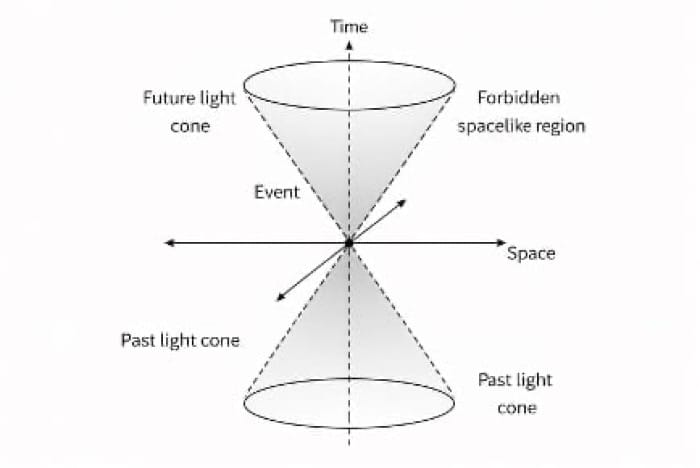
Modern physics reinforces this theological insight in an unexpected way. Physics does not treat causality as a philosophical preference. It encodes causality mathematically.
The geometry of spacetime restricts influence to light cones. Events may affect only those events that lie within their future light cone. Lorentz transformations ensure that if information were to travel faster than light, temporal order would invert in some valid frames of reference. Effect would precede cause. Physics therefore forbids faster-than-light signaling, not as an arbitrary rule, but as a requirement for consistency.
Causality in physics must therefore be universal rather than local. It cannot hold merely in most cases or under ordinary conditions. A causal violation, even if rare, would not remain confined to its point of origin. Because physical systems interact, a single breakdown of causal order would propagate uncertainty, undermining the reliability of measurement everywhere.
For this reason, physics treats causality as structural rather than statistical. It is not an observed regularity that happens to persist. It is a constraint that must be preserved if the concept of observation is to remain coherent. If cause and effect could invert even occasionally, no experiment could be trusted, because the outcome might influence the conditions under which it was performed.
This universality reinforces the theological claim that causality is a law governing finite reality as such. It is not an emergent habit of matter, nor a provisional rule awaiting exception. It is a necessary condition for intelligibility within creation, binding all physical processes precisely so that knowledge, agency, and responsibility remain possible.
Classical field equations are hyperbolic, ensuring that disturbances propagate at finite speed. Quantum field theory enforces microcausality by requiring that operators commute at spacelike separation. Even in the quantum domain, no usable information may travel backward in time.
Physics does not merely assume causality. It must enforce it in order to remain intelligible. Without causal order, there could be no observation, no experiment, no prediction, and no science.
This reveals something profound. Physics presupposes an order that can be consistently observed, measured, and understood. The universe is not merely existent. It is intelligible.
The Logos of Physical Constraint
The refusal of physics to permit causal inversion, the mathematical enforcement of sequence, suggests that the universe is not merely a collection of brute facts, but a structured expression of Logos. Modern physical theories, from the hyperbolic nature of classical field equations to the microcausality of quantum field theory, are constructed to forbid the unintelligible collapse of cause and effect. This structural necessity implies that reality is ordered prior to our discovery of it, as the laws of physics do not merely describe what happens, they preserve the conditions under which anything can be known at all.
If, as theology maintains, the universe is a created order, then these causal constraints are not arbitrary barriers to our power. Rather, they are the architectural expressions of a divine mind that intends for reality to be observable, measurable, and meaningful for the creatures who inhabit it.
The enforced rational order of the universe suggests that intelligibility is given rather than accidental, a conclusion traditionally expressed as creation by rational intention rather than chance.
Intelligibility, Observation, and the Limits of Reductionism
Observation presupposes order. Measurement presupposes stability. Explanation presupposes sequence.
Without causality, there could be no observer and nothing observable.
Materialism attempts to ground intelligibility in brute fact. Order simply exists, it claims, without reason or explanation. Yet brute fact cannot explain why the universe is not merely ordered, but knowable. Laws that can be discovered, tested, and mathematically described presuppose coherence prior to discovery.
Determinism fares no better. A fully deterministic universe still presupposes intelligibility. Fixed outcomes do not explain why the structure of reality aligns with rational investigation. A block universe may describe spacetime geometrically, but it cannot explain why minds embedded within that block can reliably know its structure.
Quantum appeals to the observer are often misunderstood. Human observation does not bring reality into existence. Measurement reveals states already constrained by law. The deeper point is not that observers create reality, but that reality is ordered such that observation is possible at all.
Such order presupposes mind, not as a component within the system, but as the ground upon which the system is intelligible. God is not an observer within the universe. God is the condition under which the universe is observable.
Why Humans Cannot Exist Outside Time
The contrast between divine timelessness and creaturely existence must be made explicit because it is here that many modern intuitions quietly fail. It is tempting to imagine that liberation from time would represent a higher form of existence for human beings, an escape from limitation, error, and consequence.
Yet this intuition confuses divine fullness with creaturely dissolution. What is perfection for God would be annihilation for us. Human consciousness is structured by sequence. We remember, we attend, and we anticipate.
Memory anchors identity to a fixed past. Anticipation opens the future to hope or fear. Attention binds the present into coherence. Remove sequence, and these faculties do not merely function differently, they cease to function at all. A timeless human mind would not possess infinite awareness. It would possess no awareness because awareness itself presupposes succession.
Embodiment intensifies this dependence. Bodies exist in space and therefore in time. Movement requires before and after. Growth requires duration. Injury and healing require sequence. A body outside causality would not be glorified. It would be undefined. This is why Scripture never promises disembodied eternity as the final hope. The promise is resurrection, not escape. Moral life also presupposes temporal order. Repentance has meaning only if the past remains fixed. Forgiveness does not erase what occurred. It redeems it. Love acquires weight because it is chosen under conditions of irreversibility. Sacrifice matters because it cannot be undone.
A timeless moral agent would be incapable of responsibility, not because it would be innocent, but because responsibility requires consequence. This clarifies why divine timelessness cannot be shared directly by creatures. God’s mode of being is complete act.
If the physical world requires the speed of light to protect causality, the moral world requires the arrow of time to protect the soul. We often imagine that a life without sequence would be a liberation, yet such an existence would actually be a form of creaturely dissolution. Human consciousness is inherently structured by succession, as we are anchored to a fixed past through memory and pulled toward an unresolved future through expectation.
Without this causal scaffolding, the moral life would vanish, because responsibility requires that an action, once taken, remains truly done. Repentance only possesses meaning because the past is immutable and sacrifice only carries weight because it is chosen under the conditions of irreversibility. In this light, the constraints of time are not a punishment for our finitude, they are the very conditions that allow love to be authentic and choice to be consequential. To exist outside of this sequence would not make us more like God, it would unmake the very structure of human personhood.
Resurrection, then, is not the abolition of temporal identity but its fulfillment. What was formed through sequence is preserved without decay. What was chosen under causality is retained without loss. Eternity does not replace history. It gathers it into completion.
Mortal Life and the Necessity of Causal Sequence
Human beings are finite, embodied, and developing. We do not possess our ends fully. We move toward them through growth, failure, repentance, and learning. All of this presupposes sequence.
Causality stabilizes agency. A decision matters because it cannot be undone. Responsibility matters because consequences persist. Repentance matters because the past remains fixed even when forgiveness is granted. Hope matters because the future is not yet resolved from within time.
Causality is not imposed as punishment. It is imposed as a scaffold for meaning. It binds freedom to responsibility and action to consequence so that life can be morally serious rather than arbitrary.
Resurrection, Revelation, and the Fulfillment of History
Christian hope is not disembodied escape. It is resurrection. The soul’s intermediate state is not the final form of human existence. The resurrection body is embodied yet transformed. It is imperishable and no longer subject to death.
The apostle Paul insists on continuity as well as transformation. What is raised is the same person, yet no longer subject to decay or limitation. Embodiment remains, but mortal constraints do not. The resurrection body participates in eternity without being bound by temporal development.
The Book of Revelation brings this hope to its narrative culmination. Seals are opened. Trumpets sound. Bowls are poured out. Judgment unfolds. Worship follows vision. Kings bring their glory into the New Jerusalem. Nations walk by its light. The tree of life bears fruit for healing.
This is not a failure of imagination. It is theological necessity. Revelation is given to temporal beings. Vision must be narrated. Understanding must unfold. Even when Scripture speaks of the end of time, it speaks within time.
The declaration that time shall be no more does not signify the annihilation of order. It signifies the end of unfinished, mortal time. Chronological striving gives way to consummation. History is not erased but fulfilled.
The New Jerusalem is spatial. Relationship remains. Meaning endures. Eternity preserves intelligibility because it preserves fulfillment rather than dissolving it into abstraction.
It is important to note that the enforcement of causality within creation does not imply rigidity or determinism. Causal order establishes sequence, not inevitability. Within that sequence, freedom operates, contingency persists, and novelty genuinely arises. The created order is therefore not a mechanical script but a structured arena in which meaningful action can occur. This distinction prevents a common confusion. Causality makes choice consequential, but it does not make choice illusory. On the contrary, without a stable causal framework, freedom itself would have no enduring significance, because no action could reliably shape what follows.
Conclusion
God does not exist within time or sequence. Causality, therefore, is not an ultimate feature of reality but a created law governing finite existence, grounded in God and binding upon creatures. It orders human life so that freedom can be meaningful, responsibility coherent, and truth intelligible. What governs creatures does not govern God.
This order is not accidental. Physics reveals how causality is enforced as a structural requirement for observation. Philosophy clarifies what such sequence makes possible for reason, language, and moral agency. Theology explains why this order exists at all, not as a constraint imposed upon creation, but as the condition under which created life can be known, chosen, and formed.
Causality is often mistaken for a limitation to be overcome. In fact, it is what makes human action serious. A decision matters because it cannot be undone. Love carries weight because it is chosen under conditions of irreversibility. History matters because it does not dissolve once it has passed. Without causal order, neither science nor morality could endure, because neither observation nor responsibility could survive.
The hope of resurrection does not abolish this order but completes it. What is formed through time is not erased but gathered. What is chosen under causality is not undone but retained without decay. Eternity does not negate history. It perfects it.
Causality is not the deepest law of reality. But it is the law under which finite beings are formed. Until that formation is complete, causality remains not a burden imposed upon creation, but a necessary mercy that makes knowledge, freedom, and communion possible at all.
References
Einstein, Albert. Relativity: The Special and the General Theory. Translated by Robert W. Lawson. New York: Henry Holt and Company, 1920.
Hawking, Stephen, and George F. R. Ellis. The Large Scale Structure of Space-Time. Cambridge: Cambridge University Press, 1973.
Penrose, Roger. The Road to Reality: A Complete Guide to the Laws of the Universe. New York: Alfred A. Knopf, 2005.
Wald, Robert M. General Relativity. Chicago: University of Chicago Press, 1984.
Weinberg, Steven. The Quantum Theory of Fields. Vol. 1, Foundations. Cambridge: Cambridge University Press, 1995.
Sommerfeld, Arnold, and Léon Brillouin. Wave Propagation and Group Velocity. New York: Academic Press, 1960.
Minkowski, Hermann. “Space and Time.” In The Principle of Relativity, edited by H. A. Lorentz et al., 75–91. New York: Dover Publications, 1952.
Kant, Immanuel. Critique of Pure Reason. Translated by Norman Kemp Smith. London: Macmillan, 1929.
Popper, Karl. The Logic of Scientific Discovery. London: Routledge, 1959.
Wittgenstein, Ludwig. Philosophical Investigations. Translated by G. E. M. Anscombe. Oxford: Blackwell, 1953.
Ricoeur, Paul. Time and Narrative. Vol. 1. Translated by Kathleen McLaughlin and David Pellauer. Chicago: University of Chicago Press, 1984.
Earman, John. Bangs, Crunches, Whimpers, and Shrieks: Singularities and Acausalities in Relativistic Spacetimes. Oxford: Oxford University Press, 1995.
Augustine of Hippo. Confessions. Translated by Henry Chadwick. Oxford: Oxford University Press, 1991.
Aquinas, Thomas. Summa Theologiae. Translated by the Fathers of the English Dominican Province. New York: Benziger Brothers, 1947.
Gilson, Étienne. The Christian Philosophy of St. Augustine. New York: Random House, 1960.
McCabe, Herbert. God Matters. London: Continuum, 1987.
Feser, Edward. Aquinas: A Beginner’s Guide. Oxford: Oneworld Publications, 2009.
Ratzinger, Joseph. Introduction to Christianity. Translated by J. R. Foster. San Francisco: Ignatius Press, 2004.
Polkinghorne, John. Science and Theology: An Introduction. Minneapolis: Fortress Press, 1998.
Plantinga, Alvin. Where the Conflict Really Lies: Science, Religion, and Naturalism. Oxford: Oxford University Press, 2011.
Arendt, Hannah. The Human Condition. Chicago: University of Chicago Press, 1958.
Williams, Bernard. Moral Luck. Cambridge: Cambridge University Press, 1981.
Ricoeur, Paul. Memory, History, Forgetting. Translated by Kathleen Blamey and David Pellauer. Chicago: University of Chicago Press, 2004.
Wright, N. T. The Resurrection of the Son of God. Minneapolis: Fortress Press, 2003.
Irenaeus of Lyons. Against Heresies. Translated by Alexander Roberts and William Rambaut. In Ante-Nicene Fathers, Vol. 1. Buffalo, NY: Christian Literature Publishing, 1885.
Disclaimer: The views and opinions expressed in this article are solely those of the author and do not necessarily reflect the views, positions, or policies of any employer, organization, or institution.