A Christmas Carol for the Age of AI
Charles Dickens warned that systems built on efficiency alone erode dignity as surely as wages. Two centuries later, artificial intelligence is reviving that lesson in a new form.

Every December, we revisit A Christmas Carol as a morality tale about generosity and redemption. But Dickens’ real target was an economic system that left clerks like Bob Cratchit expendable and anxious. Nearly two centuries later, as artificial intelligence advances into the workplace, those shadows reappear in new form. Scrooge’s ledger books have become algorithms, and the same question hangs over the modern economy. What happens to workers when efficiency becomes the only measure that matters.
Dickens wrote during a period when industrial expansion created immense wealth for a few and insecurity for many. Factories could replace skilled workers overnight, and clerks like Cratchit had little bargaining power in a labor market flooded by urban migration. With no minimum wage, job protections, or social safety nets, workers lived at the mercy of employers who prized output above well being. Dickens used Scrooge not as a villain, but as a mirror held up to a system that rewarded efficiency while ignoring its human cost. His novella remains powerful because he understood that an economic model built only on productivity can erode not just wages but dignity.
The early Industrial Revolution brought real hardship and dislodged countless workers from their crafts, yet as it matured it became the force that lifted much of the world out of poverty.
That reality is resurfacing in modern form. Today’s white collar workforce occupies a similarly fragile position. Artificial intelligence is automating tasks once handled by clerks, assistants, analysts, and entire customer service departments. What machines did to Victorian artisans, algorithms are now doing to knowledge workers, turning specialized skills into interchangeable functions that can be performed instantly, tirelessly, and at scale. Bob Cratchit’s insecurity is no longer a relic of the nineteenth century. It has reappeared in the quiet worry of millions who sense that a digital replacement can now do in seconds what once justified their jobs.

The change is not theoretical. Banks use artificial intelligence to analyze transactions that once required large teams. Law firms use it to screen thousands of documents that used to sustain young associates. Health care systems rely on models to summarize patient notes and manage communication flows that once justified administrative staff. The technology is improving so quickly that tasks once thought safe from automation are being absorbed with surprising speed. The effect is the same one Dickens saw. When the value of labor is reduced to the speed of the tool that performs it, the worker becomes the most vulnerable part of the system.
Artificial intelligence is giving employers something Victorian industrialists could only dream of, a nearly unlimited supply of tireless digital labor. As software takes on everything from customer inquiries to financial analysis, the leverage once held by workers shrinks. It is the same imbalance that left Cratchit grateful for a meager wage and terrified of losing it.
While Scrooge’s redemption is a triumph of the heart, his transformation also highlights a precarious Victorian reality: the survival of the Cratchit family rested entirely on the personal whims of a single employer. In the nineteenth century, without the scaffolding of a minimum wage or social safety nets, kindness was a fragile exception rather than a systemic rule. Today, as we face an AI-driven shift in labor, we must consider if individual corporate benevolence, the "Fezziwig approach”, is enough to withstand a global market that rewards "Scrooge-like" efficiency above all else.
The danger of relying solely on the "Fezziwig model" in the digital age is that a compassionate company may find itself at a competitive disadvantage against rivals that use AI to slash costs at any human price. To ensure that "human regard" does not become a luxury, we must look beyond individual generosity toward systemic policy. Just as the hardships of the Industrial Revolution eventually gave rise to labor protections, the age of AI requires a new social contract—one where dignity is secured by the structure of the law rather than the benevolence of a manager. By institutionalizing the spirit of Fezziwig through modern safeguards, such as national reskilling initiatives or portable benefits, we ensure that the pursuit of progress does not become an "idol" that leaves the modern Cratchit behind.
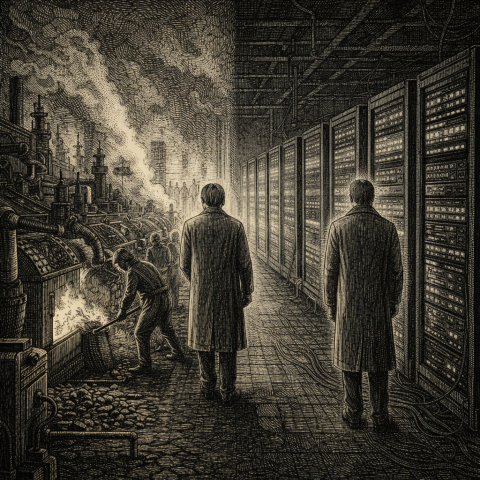
Yet Dickens also believed in the possibility of change. He never condemned progress. He condemned progress that forgot people. His spirits came not to freeze time but to warn Scrooge that the future was still malleable if he chose differently. We stand in a similar moment. Artificial intelligence can raise living standards and relieve burdens, but only if we resist treating workers as expendable inputs in an endless quest for efficiency. Companies that choose a Fezziwig approach, one that considers the human consequences of innovation, can build loyalty and trust that no model can produce.
Dickens did not argue against enterprise. He argued that enterprise without regard for people becomes something smaller than progress.
The Ghost of Christmas Yet to Come showed Scrooge a future shaped by neglect. Our own future depends on whether we recognize today’s Cratchits and act before that warning becomes our reality. The choices we make now will determine whether artificial intelligence becomes another idol that displaces human worth or a tool that strengthens the bonds Dickens believed every society must protect.
References & Further Reading
Dickens, Charles. A Christmas Carol. London: Chapman & Hall, 1843.
Thompson, E. P. The Making of the English Working Class. New York: Vintage Books, 1963.
Polanyi, Karl. The Great Transformation. Boston: Beacon Press, 1944.
McKinsey Global Institute. Jobs Lost, Jobs Gained: Workforce Transitions in a Time of Automation. McKinsey & Company, 2017.
International Monetary Fund. Artificial Intelligence and the Future of Work. IMF Staff Discussion Note, 2024.
World Economic Forum. The Future of Jobs Report. World Economic Forum, latest edition.
Arendt, Hannah. The Human Condition. Chicago: University of Chicago Press, 1958.
Borgmann, Albert. Technology and the Character of Contemporary Life. Chicago: University of Chicago Press, 1984.
Disclaimer: The views and opinions expressed in this article are solely those of the author and do not necessarily reflect the views, positions, or policies of any employer, organization, or institution.